


How to Choose PU Round Belt Diameter and Tension for Conveyor and Packaging Equipment
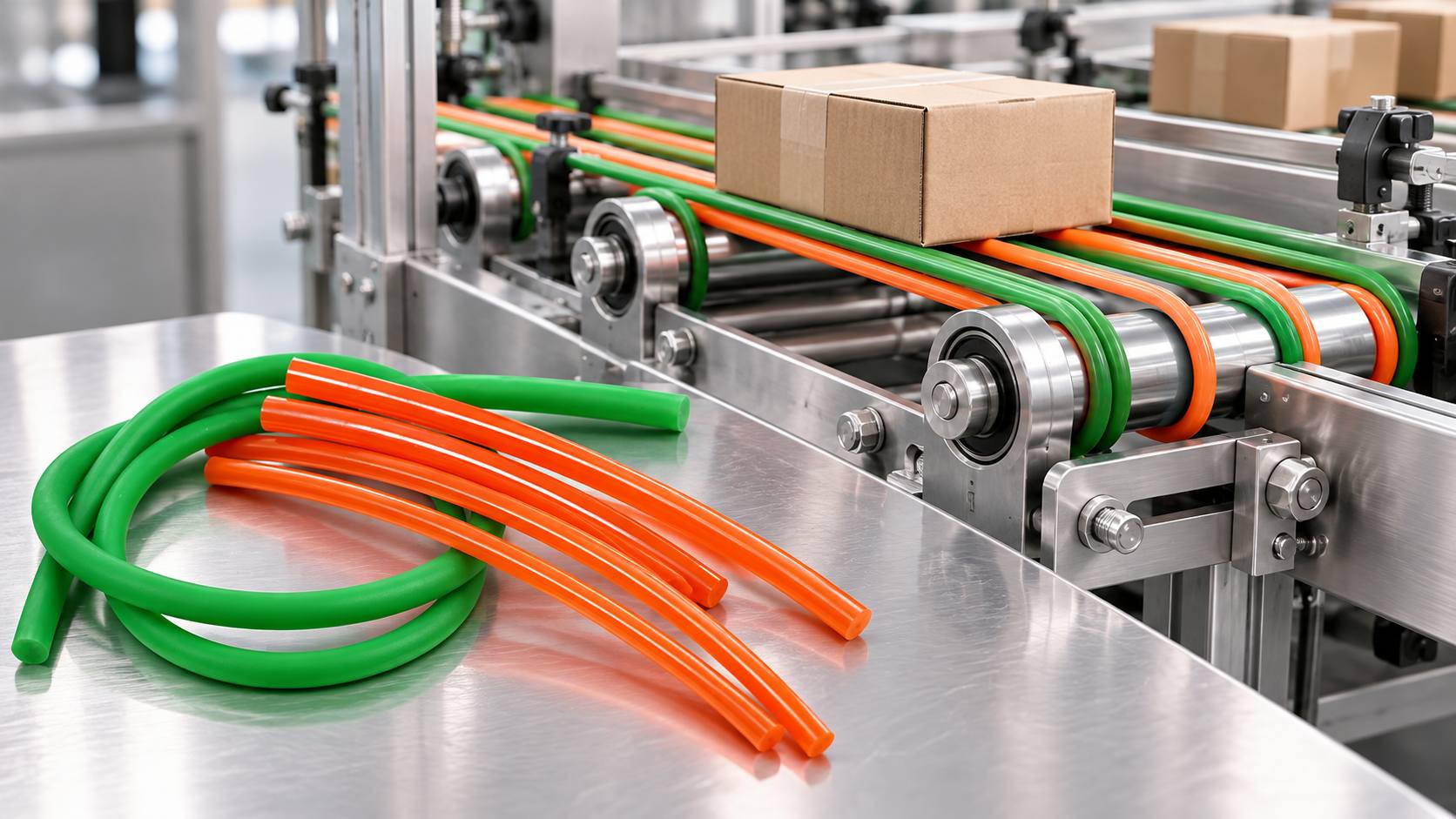
Choosing the right PU round belt for your applications such as for use on conveyors and packaging machinery requires more consideration than just the diameter of your current belt. A belt that starts to slip whilst under start up torque may have insufficient tension but this could also be caused by unsuitable pulley design, excessive load or wrong hardness of belt material. Simply increasing tension without being able to establish the cause of slip could lead to accelerated wear and additional stress on bearings. Our detailed advice for choosing suitable belts starts with an understanding of the inter relationship of diameter, pulley dimensions and belt installation stretch.
How Does PU Round Belt Diameter Affect Drive Performance?
The diameter of the belt can affect the load it can carry, flexibility and compatibility with the pulley groove. A thicker polyurethane round belt has more cross-section material but requires more space and suitable bending conditions.
How should diameter be matched to operating load?
For a round belt, the cross-sectional area is calculated by using the formula A = πd²/4. Thus a 6 mm wide belt has an area of about 28.3 mm² and an 8 mm wide belt has an area of about 50.3 mm², which is some 78% more than the cross-sectional material of the 6 mm belt. However, the increased potential of the larger belt for transmission does not necessarily translate into a corresponding increase in usable transmission capacity.
The actual performance of lightweight conveyor rollers can be influenced by several factors, such as permissible tension, material properties, contact between pulleys and operating speed. Depending on the required service, different diameters can be specified for identical applications, especially in case of higher loads or more frequent acceleration.
Why should hardness be considered?
The polyurethane hardness of a belt determines how much it will stretch and bend, as well as how much contact it has with the pulley. Softer polyurethane will conform more to the surface of the groove than a harder grade, and react differently under repeated loading than a harder grade.
Diameter and hardness should be evaluated together for the specific application for which the drive is intended. Manufacturer data and actual machine testing are far better indicators for selecting a belt than just appearance.
What Pulley Dimensions Should Engineers Check?
Not even a correctly sized belt can prevent slipping or excessive wear when the pulley groove is unsuitable. The groove must provide constant contact with the belt and must not squeeze it too much or allow it to move incorrectly.
How do groove dimensions affect belt selection?
An under-sized groove will tend to over-compress the belt material, while an over-sized groove or a worn groove will reduce the effective area of contact between the belt and pulley. Also, misalignment of pulleys and surface contamination can create similar problems.
Before switching to a wider belt, first check the pulley’s groove width and depth, as well as its alignment and surface condition. An increase in belt diameter does not necessarily result in more traction; in fact, it can even lead to more stress on the belt.
Why does pulley diameter matter?
A polyurethane belt can bend when passing around a pulley. Small pulleys create tight bending conditions that lead to repeated material deformation.
The minimum pulley diameter depends on the belt grade and diameter. Here an example: If a manufacturer specifies a minimum ratio of pulley-diameter to belt-diameter of 8, for a 6 mm belt a pulley-diameter of at least 48 mm has to be chosen. This is just an example and not generally valid.
How Can PU Round Belt Length and Tension Be Calculated?
The installed length of a belt is the length along the centers of all pulleys. The free length of a belt is the length of the belt laid out on a flat surface. If these two lengths are confused, the wrong installation tension can result.
How is the belt path estimated?
A basic open-belt drive approximates the following path length:
L = 2C + π(D + d)/2 + (D − d)²/(4C)
Here we show that C is the pulley center distance, and D and d are the larger and smaller effective pulley diameters.
For a 400mm long center, and 80mm/50mm pulleys, the estimated path length for this drive would be approximately 1,005mm.
How much initial stretch is appropriate?
Elongation at installation is influenced by several factors like belt diameter, hardness, material and operating load. There is no generic percentage for elongation that is applicable for all PU round belts.
The free length can then be calculated once the manufacturer has confirmed the approved elongation.
Free length = Installed path length / (1 + elongation)
The free length of this belt is approximately 948mm based on an illustrative elongation of 6%. This value is only an example calculation and does not represent a specification of AISILI products.
High tension increases bearing loads and causes excessive wear on belts. Low tension can cause slip. The aim is to provide reliable power transmission without excessive mechanical stress.
Why Do PU Round Belts Slip or Wear Prematurely?
Belt slip and wear are not always a problem of the belt itself. Misalignment of the pulleys, excessive load, incorrect length, as well as poor groove condition can also cause problems.
|
Problem |
Possible cause |
Recommended check |
|---|---|---|
|
Startup slipping |
Insufficient traction or excessive load |
Tension and drive load |
|
Frequent breakage |
Excessive stretch or bending |
Free length and pulley diameter |
|
Uneven wear |
Misalignment or damaged groove |
Pulley alignment |
|
Bearing overheating |
Excessive belt tension |
Installation tension |
Instead of continually trying to tighten a worn belt, investigate the original design requirements for that part. Visible cracking, severe wear, or damage to joints indicate that it is time to replace the belt.
What Should OEM Buyers Confirm Before Ordering?
A quote based on belt diameter and quantity alone does not provide sufficient assurance of suitability for a specific application. For conveyor or packaging equipment, in addition to the belt diameter and quantity, we require the material hardness, pulley dimensions, center distance, operating speed, load etc. and required elongation as well as the desired supply format.
Initial evaluation of the samples should be conducted on the intended machine. This evaluation should take place during start-up as well as at maximum loading. Subsequent checks with respect to tracking, slipping, wear as well as changes in tension after the initial operation will show up potential defects before a large production order is placed.
For repeated purchases, also agree on the dimensional tolerances and material consistency with the supplier.
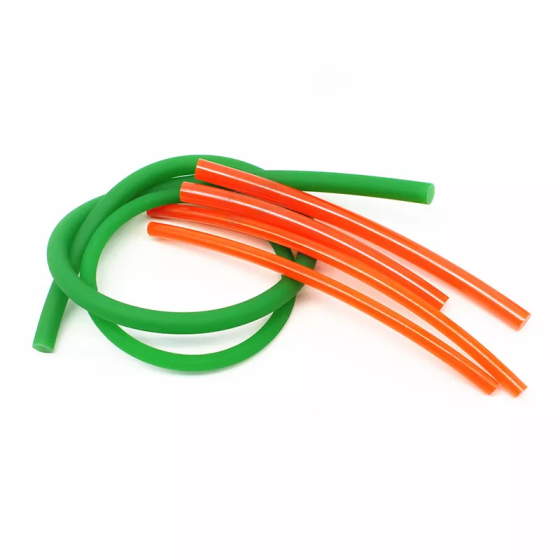
Looking for PU Round Belt Support for Conveyor Projects?
Yantai Aisili New Material Co., Ltd. is a supplier of polyurethane products. The PU Round Belt from this company is designed for use with conveyors and other transmission equipment. It is available in a variety of diameters and other dimensions to suit specific requirements.
OEM customers should provide pulley sizes, belt sizes, hardness required, working conditions etc and quantity they require for us to select the appropriate products for sampling.
Conclusion
Selecting a PU round belt requires balancing diameter, hardness, pulley geometry, and installation tension. A larger belt or higher tension will not necessarily solve slipping if the underlying problem involves drive geometry or operating load. Clear specifications and realistic sample testing help OEM buyers reduce replacement errors and maintain more reliable conveyor performance.
FAQs
1. How do I choose the right PU round belt diameter?
Transmitted load, pulley dimensions, belt material, operating speed, and manufacturer-specified limits all play a role when selecting power transmission components.
2. What is the correct tension for a polyurethane round belt?
Tension will vary by material type and by application. Go with the approved installation elongation for your specific drive from the manufacturer’s approved installation instructions rather than some generic percentage.
3. Can a larger belt diameter reduce slipping?
This may sometimes occur but is very much dependent upon pulley size and application. Slipping can occur due to misalignment or inadequate contact.
4. Why does a PU round belt break frequently?
The causes of this failure could be: excessive tension, small pulley diameter, failure due to misalignment, repeated overloading, and cracking around a welded joint.
5. What information should buyers send to a PU round belt supplier?
Belt diameter, hardness, pulley dimensions, center distance, weight, speed, required tension, supply format and order quantity.