


Why Does a Pneumatic Check Valve Leak Backward at Low Differential Pressure?
The revealing part of a shutdown is often its tail, when the two valve-port pressures are nearly equal. A valve tested only with a substantial reverse pressure has not been tested at that point in the cycle. Forward opening, return to the seat and leakage through a seated valve describe different events. The cracking value belongs to the first event. A machine losing its retained pressure needs evidence about the other two, particularly when the change from forward to reverse flow happens slowly.
Read the Pressure on Each Side
On the circuit sketch, A denotes the allowed-flow inlet and B the outlet. With air moving forward, the reading at A is higher. When B becomes the higher reading, the valve faces reverse differential. The readings need to come from the two valve ports. Once shutdown traps air at B, the supply regulator’s gauge is describing a different part of the circuit. At the end of the cycle, the needles may look level even though a small difference persists below the gauges’ resolution. Use instrumentation able to resolve the difference under investigation.
Opening and Closing Follow Different Paths
An opening test approaches from increasing forward pressure and stops at the first detectable flow. For closure, the starting position is an open flow path and the element has a return movement to complete. The moving element must return far enough to establish the specified sealing contact. Pressure on the element and any spring force contribute to that contact, so some designs need reverse pressure before they seal. The word “check” on its own gives no value for that requirement.
|
Term |
What it establishes |
What remains unknown |
|
Cracking pressure |
Start of forward flow under a stated method |
Reverse leakage after flow stops |
|
Reseal condition |
Pressure history at which closure meets the stated criterion |
Performance outside that history |
|
Reverse leakage limit |
Allowed flow at specified pressures and conditions |
Leakage at a lower, untested differential |
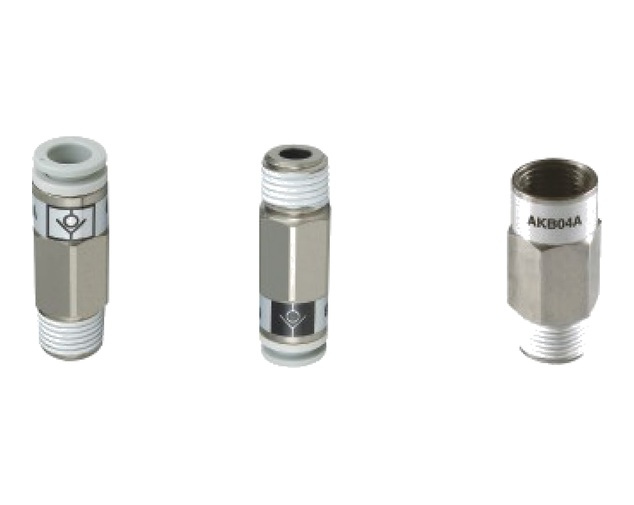
Connection appearance can mislead the investigation. The threaded and push-in bodies in a stainless pneumatic fitting range can look alike from the outside while doing quite different jobs inside: closing a line, restricting flow or preventing its reversal. Find the installed part’s symbol before choosing which pressure sequence to apply. The tube connection does not identify the mechanism inside it.
Did Air Cross the Seat or Leave Somewhere Else?
A falling outlet gauge is an observation of a volume. It does not identify the route by which pressure changed. A connected actuator, another valve passage or a test adapter can empty that volume without reverse flow through the suspect seat. Even with no escape path, air cooling after the volume was charged can bring the reading down.
Separate the Valve from the Circuit
The comparison requires a suitable fixture set up by qualified personnel. With the supply isolated, vent each trapped section by its intended means and verify both ports are depressurized before loosening an adapter. An empty inlet is particularly easy to misread here: retaining air downstream is precisely the work of the non-return element. Secure a pneumatic load against movement before removing the pressure supporting it.
On the isolated fixture, identify A and B from the permitted-flow marking. Establish that the fixture itself holds, then measure reverse flow through A while B is held at the intended pressure. Record both pressures during the observation. For a decay test, keep the same known volume and account for its temperature and the time elapsed. Report the detection limit alongside a result of “no flow detected.” Changing to a more sensitive instrument changes what “not detected” means, even if nothing has changed at the seat.
When Does the Backflow Stop?
An initially brief reverse flow followed by stable sealing may reflect the closing transition. Continuing flow at the same settled differential is a different finding. A time trace lets those two cases be distinguished; an average over the whole interval can conceal whether flow eventually stopped.
Compare the Approach to the Seat
Try the two histories separately within the permitted operating limits. First observe the return from forward flow. Then examine reverse holding after the element has seated. If only the latter succeeds, the difference lies in getting back onto the seat. Increase reverse differential only within the permitted limits and note whether sealing begins. The pressure at which sealing begins helps explain the reseal behavior; it leaves the lower, unsuccessful condition unresolved.
Persistent flow after closure brings the seat contact itself into question. Dirt on a seat can leave a narrow passage. A seal changed by deformation or an incompatible medium can leave another. Examination needs to connect the failed surface with the air supplied to it. A particle recovered at that surface would be useful evidence, whereas a flushed valve may arrive with the cause already washed away. Only service it by a procedure allowed for that model.
Compare a suspect sample with an unused reference under the same sequence. A difference between samples helps locate a part-related problem. Similar results from both may instead expose a specification mismatch or a fixture limitation. Orientation should remain fixed during that comparison unless the manufacturer’s instructions allow an orientation trial.
What Must a Low-Pressure Acceptance Test Include?
The bench sequence should follow the part of shutdown where the loss occurs. A gently fading forward flow and an abrupt reversal do not bring the element back to the seat in the same way. Both sides may still be charged during either event. A trial beginning with an already seated element leaves this return journey unexamined.
Keep the Closing Event in the Test
The agreed method needs the initial A and B pressures, how they change, installation direction, medium and temperature. After the transition, allow the defined settling period and observe for the agreed duration. Set the leakage criterion against the pressure the application must retain: a continuing trickle can empty a small pilot volume long before a larger receiver shows a troublesome loss.
A pressure rating does not supply those missing conditions. Maintenance isolation and support of a pneumatic load also need the machine’s validated safety arrangement. A non-return element by itself is not evidence that either function has been provided.
Which Check Valve Sealing Conditions Need Supplier Confirmation?
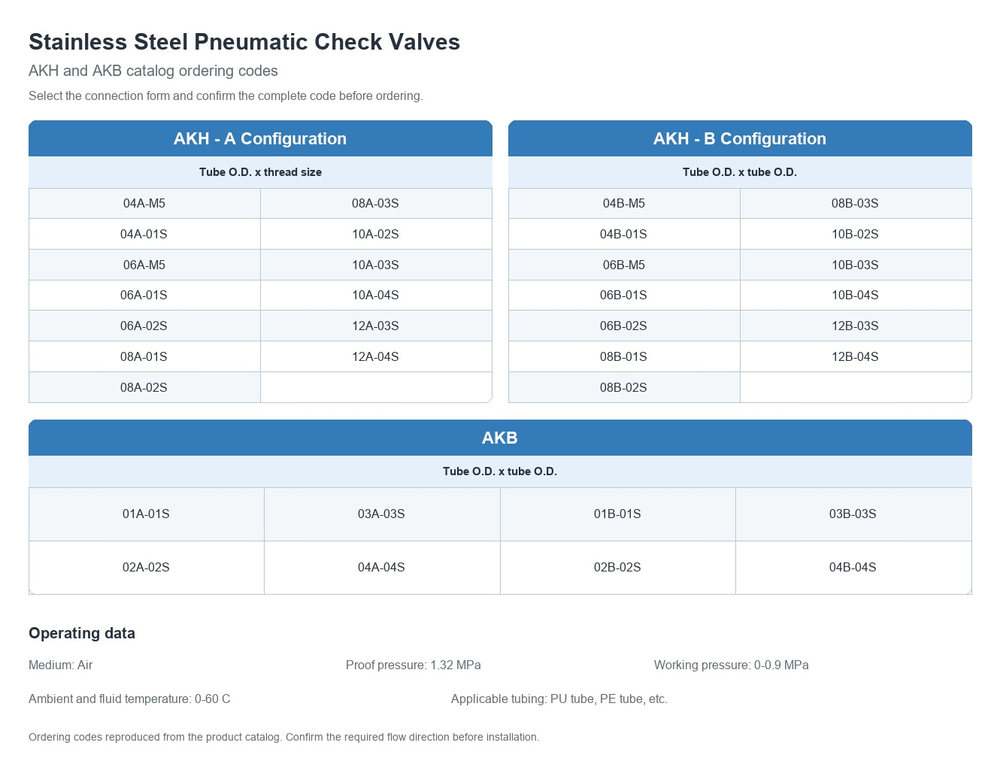
AKH and AKB stainless steel pneumatic check valves from Yantai Aisili New Material Co., Ltd. provide directional airflow control in different connection configurations. For low-differential pressure retention applications, buyers should confirm the minimum resealing differential and allowable reverse leakage under the machine’s actual shutdown conditions.
Conclusion
A reverse-flow reading has meaning when its two port pressures and closing sequence stay attached to it. Exclude losses from the rest of the circuit before drawing that result. Then test the return from forward flow as well as holding after closure, using the relevant low differential and a stated observation period. That sequence answers the shutdown complaint more directly than a cracking value or a high-pressure holding result.
FAQs
Does low cracking pressure mean tight reverse sealing near zero pressure?
No. Cracking concerns forward opening. The supplier still needs to establish how the element reseats and what reverse leakage is allowed at the small differential of interest.
Why can shutdown differ from a successful holding test?
A holding test may start with the element already seated. Shutdown can expose the transition back to the seat, so its pressure sequence must be included in the trial.
What does a falling outlet gauge establish?
It establishes a pressure change in the connected volume. The connected volume may lose air through another path, and temperature changes affect its pressure. Locate the flow path before assigning the loss to the seat.