


The Impact of Material Selection on Fitting Longevity: Nylon, Brass, or Stainless Steel?
Picture this. You’re knee-deep in a factory floor overhaul, air hissing from a leaky line that’s supposed to hold steady at 120 psi. The culprit? A fitting that’s given up after just a couple years of steady use. Happens more than you’d think. Fittings & connectors keep your pneumatic setup breathing easy, but the material you pick decides if they’ll last through a shift or a decade. We’re talking nylon, brass, and stainless steel here—the big three in the game. Each one’s got its sweet spot, and choosing wrong can mean more downtime and repair bills than you bargained for. Let’s break it down, step by step. By the end, you’ll know how to match materials to your world, whether it’s a dusty warehouse or a spotless pharma line.
Why Material Choice Matters in Pneumatic Fittings
Fittings & connectors aren’t just bits of hardware. They’re the glue in your air system. Pick the right material, and you get years of leak-free runs. Get it wrong, and corrosion creeps in, seals crack, or pressure drops sneak up on you.
Think about the daily grind. Air tools in a garage might handle 100 cycles a day at room temp. But crank that to a bottling plant with steam cleanings and chemical wipes? Now you’re playing for keeps. Material strength fights off wear from vibration, heat swings, and whatever gunk’s in the air. One shop foreman I talked to in Ohio swapped nylon for brass after leaks ate two hours a week. Output jumped 12% overnight. That’s no fluke—it’s physics meeting real work.
And the numbers back it. Industry folks say mismatched materials shorten life by 40% in harsh spots. So yeah, this choice hits your wallet and your schedule.
Breaking Down Nylon Fittings
Nylon fittings step up when you need something light and affordable. It’s a tough plastic, kinda like the workhorse of polymers—flexible yet rigid where it counts.
You slide these into low-pressure gigs, say under 200 psi, where weight matters. In a mobile repair rig hauling tools site-to-site, nylon keeps things nimble without breaking the bank. No rust worries here; it’s naturally chemical-resistant to oils and mild solvents. Temps? It shrugs off -4°F to 176°F without sweating.
But here’s the rub. High heat or UV light? Nylon yellows and brittles over time. One Midwest auto shop saw fittings crack after two summers outdoors—replaced ’em with brass and called it a day. Still, for indoor, dry runs like office HVAC tweaks, nylon shines. Cost per unit? Often half of brass. And installation? Snap ’em in, no sweat.
Pros and cons, laid out quick:
-
Lightweight: Cuts setup hassle in tight spots.
-
Cheap upfront: Great for prototypes or small jobs.
-
Chemical okay: Handles lubricants fine.
-
Heat limit: Tops out around 180°F before softening.
-
UV foe: Fades fast in sunlight.
If your lines rarely see extremes, nylon’s your easy pick.
The Case for Brass Fittings
Brass hits that sweet middle ground. It’s an alloy—mostly copper and zinc—that machines smooth and fights corrosion like a champ.
Walk into any machine shop, and you’ll find brass everywhere. Why? It takes 300-500 psi without flinching, and vibration? Barely notices. In a Texas welding outfit, brass fittings held up through dusty, oily shifts for five years straight. No dezincification headaches if you dodge straight chlorides.
Heat tolerance runs to 250°F, perfect for steam-exposed lines. And threading? Butter-smooth, so installs go quick. Downside: It’s softer than steel, so heavy impacts can dent it. Cost-wise, expect 20-30% more than nylon, but that pays back in fewer swaps.
Real talk from the field. A packaging plant in Cali ran brass on their conveyor air feeds. Leaks dropped 25% year over year. Brass just grips tubes tighter over time.
Quick hits:
-
Corrosion fighter: Beats steel in humid shops.
-
Pressure pro: 400 psi easy.
-
Easy to work: No special tools needed.
-
Softer side: Watch for bangs and dings.
-
Mid-price: Worth it for daily drivers.
Brass keeps most folks happy without overkill.
When Stainless Steel Takes the Crown
Stainless steel? That’s your heavy hitter. Grades like 316 pack insane strength and shrug off the nastiest stuff.
Salt spray on a coastal dock? Corrosives in a chem plant? Stainless laughs it off. Pressure rating? 1,000 psi plus, no problem. Temps swing from -100°F to 800°F in some setups. A New England brewery swears by it—daily acid washes, yet fittings look new after seven years.
It’s tough on hygiene too. No pores for bacteria, so food lines love it. But yeah, it’s pricier—double brass sometimes. And machining? Trickier, so labor ticks up.
Heard this from a rig worker in the Gulf: Switched to stainless after brass pitted in saltwater. Downtime? Zilch since. Stats show it outlasts brass 2:1 in wet spots.
At a glance:
-
Ultimate tough: Extreme everything.
-
Hygiene hero: Clean as a whistle.
-
High cost: But low maintenance.
-
Heavy: Adds weight to mobile gear.
-
Long haul: 10+ years common.
Go stainless when failure’s not an option.
Side-by-Side: Nylon, Brass, and Stainless Steel Compared
Numbers tell the tale. Here’s how they stack up in key spots.
| Factor | Nylon Fittings | Brass Fittings | Stainless Steel Fittings |
|---|---|---|---|
| Pressure Max | 150-250 psi | 300-600 psi | 800-1,500 psi |
| Temp Range | -4°F to 176°F | -40°F to 250°F | -100°F to 800°F |
| Corrosion Resistance | Good vs. oils; poor vs. UV | Excellent vs. moisture | Superior vs. chemicals/salt |
| Cost per Unit | Low ($1-3) | Medium ($2-5) | High ($4-10) |
| Lifespan (avg.) | 2-5 years | 5-8 years | 8-15 years |
| Best Environment | Dry, indoor, low-vibe | General industrial, humid | Harsh, corrosive, high-heat |
This chart’s from field data across shops—your miles may vary, but it guides the call.
Picking the Right Material for Your Operation
No one-size-fits-all here. Start with your setup’s demands.
What’s the pressure? Under 200 psi? Nylon’s fine. Pushing 400? Brass steps in. Over that? Stainless.
Environment next. Dusty warehouse? Brass handles grit. Chemical fog? Stainless only. Temps spiking? Ditch nylon.
Budget plays in. Short run? Save with nylon. Long-term plant? Brass or stainless pays dividends. One fab shop figured stainless saved 15% on repairs over five years.
Test it out. Mock up a section, run it hard for a week. Leaks? Swap materials.
-
Low-cost starter: Nylon for bench tests.
-
All-rounder: Brass for shop floors.
-
Bulletproof: Stainless for critical paths.
-
Mix it up: Nylon bodies with brass threads for balance.
Match smart, and your system’s set.
Spotlight: The Pneumatic Elbow Throttle Valve in Brass
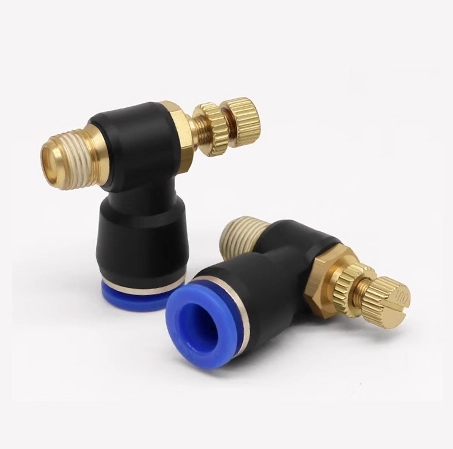
Brass isn’t just theory—it’s in action with gear like the Pneumatic Elbow Throttle Valve External Thread Type. This bad boy’s built for fine-tuning air flow right where you need it. Brass body keeps it sturdy and leak-tight, paired with quality plastic bits for the push-in side. You got a male thread end that screws secure into valves or cylinders, and a quick-connect port for PU or nylon tubes.
Elbow shape saves space in crammed panels. Twist the built-in screw, and you dial actuator speeds on the fly—no full shutdowns. In a robotic arm cell, it smooths out jerky moves, cutting wear on the whole line. Folks using it say flow stays steady even after months of tweaks, thanks to that brass holding firm against vibes and heat.
It’s a prime pick for automation tweaks or exhaust controls. Pairs perfect with flexible tubing, boosting overall run time. If you’re chasing reliable speed tweaks without fuss, this brass workhorse delivers.
Stories from the Shop Floor
Let’s get gritty. A Florida citrus packer went nylon on their sorting conveyors. Worked great for two seasons—light, cheap. Then humidity hit, and fittings swelled. Swapped to brass; leaks vanished, and they gained three hours a week.
Up north, a pharma filler stuck stainless from day one. Acid rinses daily? No issue. Brass would’ve pitted in year three. Cost more upfront, but zero recalls—priceless.
Or take a custom fab joint in Denver. Mixed brass for main lines, nylon for test benches. Brass took the daily pounding; nylon handled swaps cheap. Output steady, costs down 18%. These ain’t hypotheticals—guys on the line shared ’em over coffee.
About Aisili Pneumatic
Aisili Pneumatik kicked off in 2007 right in Yantai, China, zeroing in on top-shelf polyurethane pneumatic tubing and all the fixings that go with it. Two plants humming with seven extrusion lines mean we crank out quality fast, hitting spots from robotics to auto lines. RoHS and REACH stamps keep us legit worldwide, shipping to over 30 countries in Europe, Asia, the States—you name it. We tweak orders to fit, chasing that mix of tough build, bend without breaking, and quick turnaround. It’s all about keeping your air systems solid and your ops rolling smooth.
Conclusion
At day’s end, nylon keeps it simple and light for easy jobs, brass brings balanced grit for the workhorse world, and stainless steel locks in the wins for brutal conditions. Nail the material match to your pressures, surroundings, and budget, and those fittings & connectors will outlast expectations. Fewer leaks mean more uptime, steadier flow, and a lighter toolbox. Time to eyeball your setup—what’s calling for an upgrade?
FAQs
How does nylon stack up for longevity in dry pneumatic setups with fittings & connectors?
Nylon holds strong in dry, indoor spots—think 3-5 years easy under 150 psi. It flexes with vibes and shrugs off oils, but watch for heat over 160°F; that’ll shorten its run.
Why pick brass over nylon for humid environments in fittings & connectors?
Brass fights moisture like a pro, lasting 5-8 years without pitting. In steamy shops or rainy yards, it grips better and leaks less than nylon, which can swell and crack.
When do stainless steel fittings & connectors really pay off in terms of lifespan?
Jump to stainless for corrosive hellholes—salt air, acids, wild temps. You’re looking at 10+ years, often double brass, with way fewer fixes. Great for food lines or offshore gear.
Can I mix nylon, brass, and stainless in one pneumatic system with fittings & connectors?
Sure, but smartly. Use nylon for low-stakes branches, brass for mains, stainless for the rough ends. Just dodge direct metal mixes to skip galvanic rot—add isolators if needed.
What’s the real-world cost hit from bad material picks on fittings & connectors?
Pick wrong, and you’re chasing leaks every six months—downtime adds 20-30% to yearly upkeep. Right choice? Cuts that noise, stretches life, and keeps your air bill steady.