


How to Specify Coiled PU Air Hose Working Length for an Assembly Bench
Measure the required reach between the hose connections, including the route around any obstructions, before selecting a coiled air hose. The sample trial comes next. With the tool fitted, you can judge whether the hose pulls awkwardly at full travel or leaves a loop across the bench when the operator puts it away. Record those observations on the drawing.
Moving an outlet or a tool rack is still an option during that trial, before the arrangement is copied onto several benches. Once the setup works, purchasing needs an identifiable sample and drawing revision to order against.

Start with the Tool’s Farthest Working Position
Measure the Actual Route and Attachment Height
Measure along the proposed hose route, not across the empty space between its ends. A guard on that route means extra travel before the tube can rise to the tool. Leave the guard fitted when measuring, and start and finish at the proposed hose connections. Moving the air outlet may solve a reach problem more neatly than adding hose.
Don’t stop the reach check at the last fastening point. Getting the tool back to a rack behind the fixture can demand more movement than fastening the part, particularly when the operator works from both sides. Include those movements in the reach check. An abrupt turn there deserves a note on the drawing, even when every fastening position looks comfortable.
If you’re still deciding which format belongs on the bench, read the coiled versus straight tubing layout guide before specifying the sample. The checks below assume you’ve selected a coil and now need to approve its installation.
Leave Room at the Tool and Supply Connections
A tail folded against a connector is an obvious place to look for trouble. Move the tool sideways while watching that end. There may be extension left in the coil, yet too little straight tail or clearance to let the tube leave the fitting cleanly.
A suspended outlet’s height belongs on the drawing. Lowering it after sample approval can put the resting coil in a different place and change the direction of pull. Temporary supports matter too. Either make a support part of the finished installation or repeat the check without it.
Keep Working Reach Separate from the Resting Envelope
Record Coil Diameter, Straight Tails and Retracted Space
Put two sketches on the drawing: tool at maximum travel, then tool parked. The extended view shows the required working reach. In the parked view, look for a clear resting place. Space beside a tool rack may disappear as soon as the next workpiece is loaded, despite being empty during an initial inspection.
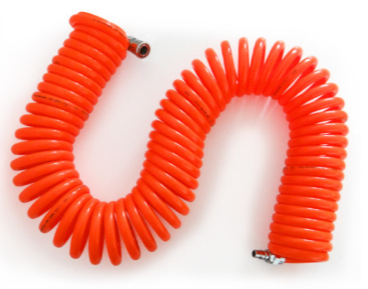
สำหรับ ท่อ Flexcoil PU, the specified 3–15 m range describes working reach between the ends. Use that definition in the order: ‘working reach between ends.’ You don’t want an inspector measuring the tube’s material length when the order was for the usable distance between connections.
The sketches also need dimensions for the coil and its straight tails, with the end directions shown. Include the nearby hardware, even if it isn’t part of the pneumatic system. A supplier reviewing the drawing needs to see the same obstacles that will be present when the hose is fitted.
Confirm the Tube Dimensions Independently
ไอซิลิ offers straight, coiled and spiral PU tube, plus pneumatic fittings and quick-connect accessories. Its customization options cover the bore and outside diameter as well as length and color. For OEM and ODM orders, customers can also specify hardness and performance requirements. A spiral hose order still needs those choices written down.
The dimensional notation also needs care. Take the 5 × 8 notation used by Aisili: the bore is 5 mm, the OD is 8 mm, and the wall measures 1.5 mm. Showing those dimensions separately saves the receiving inspector from having to interpret a size code. The diameter of the formed coil goes in another field.
Evaluate Extension and Recovery on a Representative Sample
Check Pull at Normal and Maximum Working Positions
Use the intended fittings and tool for the trial. A lightweight substitute can hide a handling problem, and a different end fitting can change the tail’s position. Commission the setup under the equipment’s established procedure. Secure hose ends before pressurization and keep people clear. In the movement trial, spend time on the normal working area before taking the tool to its farthest position.
When the tool becomes awkward to hold, leave it in that position while examining the route back to the outlet. Is a tail dragging? Has part of the coil caught another line? Photograph the obstruction and mark the tool’s position; both details will help when discussing a revised hose or route.
Some tasks need an actual pull-force measurement. The equipment designer should set the acceptance limit and agree how the reading will be taken, including its direction. There is no useful universal force limit that can be inferred from “PU recoil hose.” The tool weight, grip and task are part of that decision.
Inspect Recovery, Rubbing and End Movement
The next check begins when the tool goes back in its holder. Leave the coil untouched while inspecting its resting position. If a loop has fallen into the workpiece area, run through the return again to see where it gets displaced. Resolve any snag or rubbing point before accepting the arrangement.
Decide in advance how much repeated movement the sample evaluation will cover. Log the travel, conditions and completed cycles so the result has a defined meaning. It won’t establish lifetime performance. Any kink, visible damage or unstable connection is a reason to stop the trial and inspect the assembly.
Aisili’s PU tubing uses resilient polyurethane and has a smooth, flexible body with abrasion resistance. Its pneumatic-tool applications include impact tools, spray equipment and sanding equipment, where low weight and flexibility are relevant to handling. A material’s abrasion resistance doesn’t make a rubbing point acceptable indefinitely. Nor does a flexible tube, by itself, establish the fatigue life of the formed coil.
Confirm Airflow and Operating Conditions for That Assembly
Check tool operation through the installed hose, using the tool manufacturer’s requirements. A coil can pass the reach inspection while the complete air path still restricts the tool. An investigation of poor tool performance needs the tube ID and the fittings in that air path. Keep pressure adjustments within the ratings of every component, including when the hose has already passed the movement trial.
Aisili’s PU tube needs to stay within its rated pressure and temperature limits. As temperature rises, the permitted working pressure must come down. Excessively hot fluid and corrosive chemicals can damage the tube. Surrounding heat or chemical vapor can produce cracks, and damp or lengthy storage can bring aging or hydrolysis. Include these exposure conditions in the material review for the coil.
Do not carry a temperature limit from another PU product onto this assembly. The chosen formulation and size need their own review alongside the tool and fittings. Measure near the hose if there’s a hot process nearby. The room temperature on a factory wall isn’t necessarily the temperature that the coil will experience.
Put the Approved Geometry into the Purchase Specification
Use the drawing as the basis of the acceptance record. Alongside its geometry, enter the sample identification, tool model, fittings and the operating conditions used in the trial. Attach the marked photographs. If the outlet moved during the trial, revise the drawing before signing it off; otherwise purchasing will order against the wrong arrangement.
Aisili’s manufacturing operation includes two facilities in Yantai and Linyi with seven extrusion lines. Before production, Aisili screens incoming raw and auxiliary materials against 16 internal physical and chemical criteria. Raw-material selection and production checks support its tubing manufacture, including checks concerning burst resistance, flexibility, bend behavior and insertion or withdrawal force. For a repeat bench order, connect those manufacturing capabilities to an agreed product specification and sample, rather than accepting the description “same coil” without a revision reference.
Send the bench drawing, required reach and end-connection details when requesting a coiled hose configuration review. Include the retracted-space limit and the sample observations. The next quotation should identify the configuration that was approved, with any unresolved material or operating-condition questions answered before the production order is released.