


How Should OEM Buyers Define Pull-Out Force Test Criteria for LLDPE Tubing and Push-to-Connect Fittings?
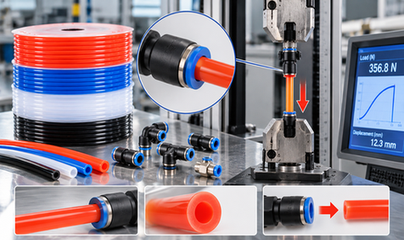
Even if the tube remains airtight during the assembly, it can still separate from the push-to-connect fitting when an external force is applied. For OEM manufacturers of equipment, this can pose a serious reliability problem that cannot be checked by simple leakage tests. Pull-out force tests can check whether a fitting can hold the tubing under specific mechanical stresses. However, results can vary greatly depending on tube dimensions and material as well as on the design and test conditions of the fitting. Thus, acceptance criteria have to be defined for the specific tube/fitting combination and not on the basis of a generally stipulated force.
Why Is Pull-Out Force Testing Important for LLDPE Connections?
A push-to-connect fitting has two functions. On the inside, it has to create a seal to prevent leakage of air or liquids. On the outside, it has to grip the tube to keep it in place. Although the functions are interrelated, a proper seal does not automatically guarantee sufficient retention.
What does a pull-out force test measure?
The pull-out force test checks the axial force that can be applied to a connected tube before it splits or suffers another kind of failure. The force is measured in Newtons using a tensile testing machine.
The fitting is secured to the test ring and the tube pulled along its length during the test. The maximum force reached prior to tube failure or verification of a specified proof load required for service connection are the end results of the test depending on test objective.
The distinction between the two suppliers’ test results is crucial: the way a supplier performs a test can lead to different results even if both are performing valid tests.
Why is a manual pull check insufficient?
A light pull check of the tubing inserted into a port by a technician provides initial engagement. However, hand force applied by different operators to achieve production acceptable torque will vary.
For OEM qualification testing is performed under controlled conditions to allow for comparison of samples, and for assessment of the retention properties of the sample throughout the production batches.
How Do LLDPE Tube Dimensions Affect Pull-Out Force?
For push-to-connect fittings that grip the outside of the tube, the outside diameter of the tube is a critical dimension for fitting retention. Additionally, the wall thickness and material stiffness of the tube determines how it will behave under localized pressure from the gripping surface of the fitting.
Can two tubes with the same OD perform differently?
Yes. All AISILI published LLDPE specifications are listed below:
|
Modelo |
OD |
Wall thickness |
Working pressure at 23°C |
|---|---|---|---|
|
LLDPE0860 |
8 mm |
1.00 mm |
10 bar |
|
LLDPE0855 |
8 mm |
1.25 mm |
12 bar |
Both of the tubes are nominally 8 mm outside diameter. However, the wall thicknesses of the two tubes are different. This difference could affect the amount of deformation of the tube at the grip but does not necessarily indicate which tube would have the highest pull-out force.
The listed pressure ratings are for the tubing and are not the same as the retention force for a given tube-and-fitting combination. Such combinations must be qualified individually where differences affect performance.
Why does material consistency matter?
LLDPE is a thermoplastic material which can exhibit different mechanical behavior depending on temperature and on long term loading. Additional factors which can affect grip of the tube by the fitting are dimensional variation, ovality, surface damage and material batch variation.
OEM buyers must establish what tubing grade has been approved, what are the dimensional tolerances and what fitting model has been used in the test. Results obtained using non-approved polyethylene tubing will not be representative of actual production results.
How Should a Pull-Out Force Test Be Performed?
A reproducible test consists of controlled sample preparation and test setup. Deviations in test results could therefore be caused by the test method rather than the connection under test.
What equipment and conditions are required?
A typical arrangement uses a calibrated tensile testing machine and a suitable fixture that holds the fitting without damaging it. The production-intent LLDPE tube is inserted according to the fitting manufacturer’s instructions before axial loading begins.
The test method must specify speed of pull, temperature, insertion depth, number of samples and failure criteria. The alignment of the test tube is critical as unforeseen bending of the test tube can affect the measured force.
Mechanical retention qualification tests are usually performed on the assembly without pressurization inside the container. Subsequent tests for pressure resistance and leakage are then performed according to agreement.
Can ISO 14743 be used as a reference?
The requirements for testing of pneumatic push-in connectors for use with thermoplastic tubing are covered in the international standard ISO 14743:2020. The framework of tests in this standard can be used to discuss requirements for tensile retention and other performance characteristics.
However, buyers should review the standard’s specified reference tubing and test conditions before applying its acceptance values to LLDPE. Values established for other thermoplastic tube materials should not automatically become LLDPE requirements.
The OEM and supplier must agree on the appropriate criteria for the application at hand.
How Should OEM Buyers Define Minimum Pull-Out Force?
Acceptance requirements need to reflect the loads that tubing is exposed to mechanically during installation, maintenance and operation.
How can a preliminary retention requirement be calculated?
An example would be that of an equipment manufacturer who design connections to resist external axial loads of 20 N or so. The design factor on offer to the engineering team might be set at a preliminary value of 2.5, thus establishing a preliminary retention value of 50 N.
This calculation is only illustrative and does not reflect an AISILI rating or a universal LLDPE acceptance value.
These requirements should be supported by an engineering assessment, related tests and the consequences of a connection failure.
It is also important to make a distinction between proof-load testing a connection and an ultimate pull-out test. A proof-load test a connection to a certain force, whereas an ultimate test is continued until failure, e.g. until the connection parts.
Both approaches can be used during the qualification phase. The test specification must clearly state which approach is to be used.
What Acceptance Criteria Should Be Included in an OEM Specification?
A documented procedure must be in place for repeat production and be consistently applied by the buyer and supplier.
|
Parameter |
Required information |
|---|---|
|
Tubing |
LLDPE grade, OD, ID and wall thickness |
|
Fitting |
Manufacturer, model and size |
|
Test method |
Proof load or ultimate pull-out |
|
Test conditions |
Temperature, pulling speed and alignment |
|
Acceptance |
Minimum force and permitted displacement |
|
Failure definition |
Separation, excessive movement or damage |
|
Sampling |
Sample quantity and inspection frequency |
Qualification of relevant properties also includes testing of temperature conditioned test specimens after repeated insertion cycles to assess potential changes in retention properties under usage conditions.
Mechanical testing for application requiring both functions to be performed, should also include verification of leakage. A part that is holding together but leaking unacceptably should not pass simply because it meets the required retention force.
Need Support with LLDPE Tubing and Fitting Qualification?
Yantai Aisili Nuevo Material Co., Ltd. is a supplier of polyurethane tubing, multi-material pneumatic tubing and related fittings for industrial uses. The company’s Tubos LLDPE is available in a variety of outside diameters, wall thicknesses and working pressures.
For OEM projects that involve making fittings and connectors, the buyer can supply tubing drawings and the buyer’s fitting requirements and operating conditions, and proposed test criteria for sample evaluation.
Clear technical requirements for products allow for the identification of appropriate product combinations and test criteria and thus form the basis for decision making when purchasing.
Conclusión
The mechanical retention of LLDPE tubing and push-to-connect fittings can be tested by means of pull-out force testing. For the definition of acceptable values, more than the nominal tube size has to be taken into account. It is necessary to define the material, the connection geometry, the application and the testing procedure. These criteria for the acceptance test have to be documented in order to achieve a more consistent supplier qualification and to avoid connection failures in production.
Preguntas frecuentes
1. What is pull-out force in a push-to-connect fitting?
This is the axial force required to release tubing from a fitting connection or the load a connection can withstand in a retention test.
2. Does ISO 14743 provide universal pull-out limits for LLDPE?
No. The applicable reference tubing, test conditions and acceptance values must first be determined and established for use with LLDPE connections using this standard.
3. Does thicker LLDPE tubing always provide better retention?
No. Retention also depends on outside diameter, tube stiffness, material properties and gripping geometry of the fitting.
4. Should pull-out testing include leakage verification?
Yes, where the application requires it. The mechanical retention function needs to be tested separately from the sealing function and assessed accordingly.
5. What should OEM buyers provide for pull-out force testing?
Tubing dimensions, material, fitting model, test conditions, required retention force, sampling requirements and failure criteria.
Anterior: Ninguno
Siguiente: How to Plan PU Pneumatic Tubing Purchasing for Seasonal and Repeat Orders