The Science Behind Polyurethane Pneumatic Tubing’s Flexibility and Durability

Pneumatic tubing made from polyurethane is a very flexible and durable material and for this reason is used in industrial automation, in robotics and in pneumatic systems in general. This special tubing has excellent characteristics thanks to its chemical composition that combines the elasticity of the tubing with the great mechanical resistance it has.
Chemical Structure and Molecular Arrangement
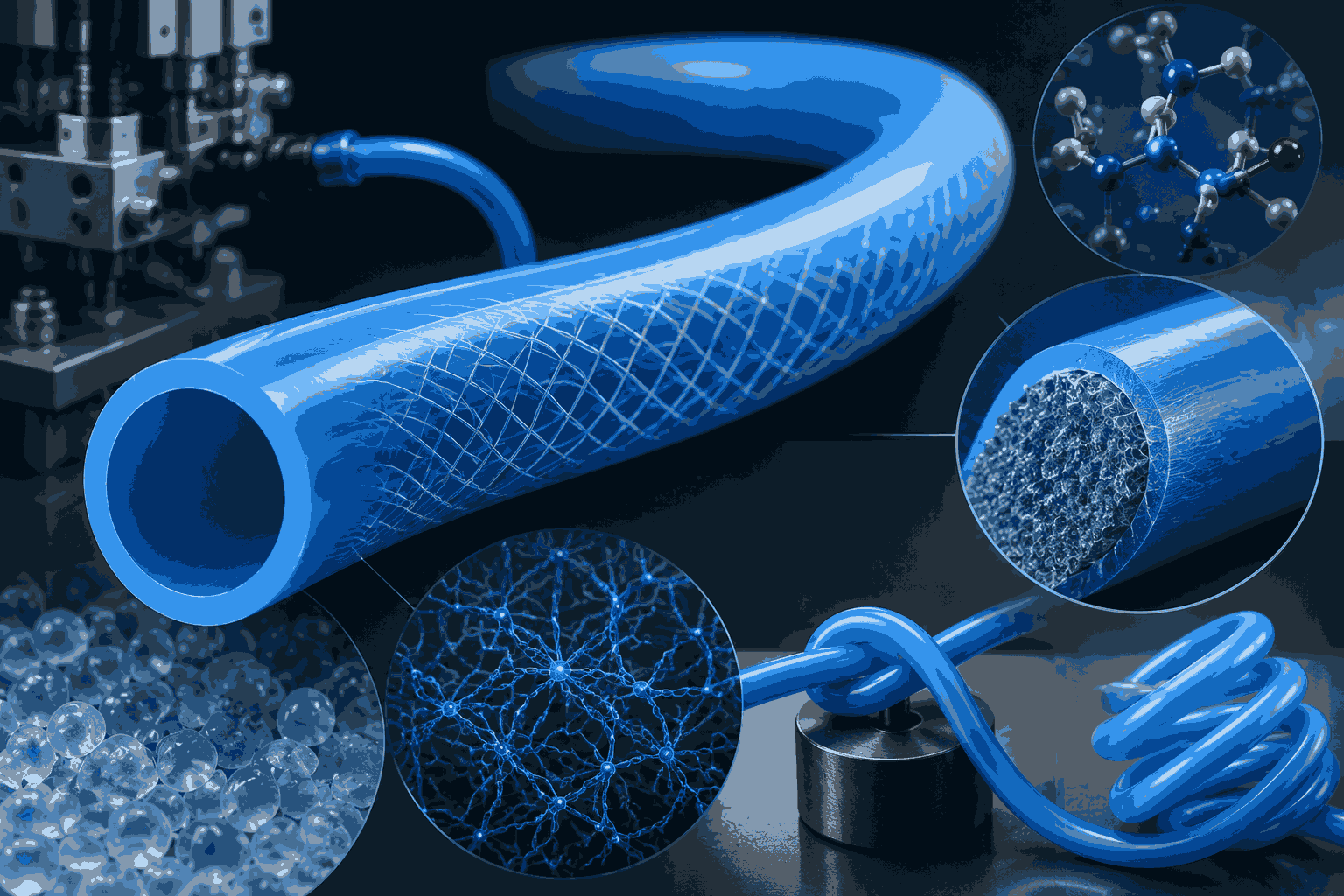
The molecular chain are flexible, elastic, and are responsible for the tube’s properties regarding tensile- and polyurethane tube has a molecular structure with alternating soft and hard segments. The soft segments of the compression- resistance, whilst the hard segments are rigid, give strength to the network, and resistance against breakdown of the molecule by heat, chemicals, etc. The proportion of soft- and hard-segments is critical and is dictated by the processing conditions. The tube is then designed for a particular field of application, and maintains its shape and gives the required properties when subjected to repeated- cyclic stress or variations.
Influence of Polymer Crosslinking on Mechanical Properties
An important aspect of how mechanical properties can be influenced by crosslinking of polymers in polyurethane materials is explained first. By controlled crosslinking the tensile strength of polyurethane materials is increased without loosing flexibility. Materials with too high crosslink density are brittle, which in tube application leads to a short lifetime, due to the low mobility of the chains. Only an optimised material formula allows a constant mechanical behaviour in different pressure conditions. This material is suitable for dynamic pneumatic applications.
Which Factors Contribute Most to Flexibility in Polyurethane Tubing?
The flexibility of polyurethane pneumatic hose is one of the primary characteristics that separate it from other materials such as PVC or nylon. The ability of a material to be flexible is greatly affected by a number of molecular and environmental conditions.
Role of Soft Segment Chemistry in Elastic Behavior
The type of polyol used affects the flexibility of the tubing, especially elasticity and low-temperature flexibility. エーターベースのポリウレタン管 is more flexible than ester-based products. This is due to the mobility within the polymer matrix enables the tubing to be bent repeatedly without permanent deformation. Thus, the tubing is able to withstand many motion cycles without cracking or permanent set.
Impact of Temperature and Environmental Conditions on Flexibility
Temperature is also an important factor affecting flexibility of a coating. Due to its nature of being a thermoplastic polyurethane, our coating is flexible over a wide range of temperatures. While it may temporarily change the modulus of a coating when it is exposed to high or low temperatures, such change is always temporary. The polymer chains would revert to their original configuration when the coating is returned to normal ambient temperature. Many additives, such as plasticizers, are used to enhance stability of flexibility of a coating over time while environmental conditions are changing. These additives function by reducing the intermolecular forces within the polymer network to improve flexibility.
How Do Mechanisms Enhance Durability in Polyurethane Pneumatic Tubing?

The without any deterioration over time. The pneumatic tubing made of polyurethane has a high level of term durability refers to the material’s ability to withstand mechanical stress, abrasion, and environmental influence, durability due to the special molecular composition.
Resistance to Abrasion, Chemicals, and Fatigue Stress
Our tubing is high in abrasion resistance due to the tight molecular structure and hard surface that resists abrasion and allows for smooth sliding against metal fittings and other surfaces. Polyurethane tubing is oil resistant, fuel resistant and resists many solvents. This makes it an ideal tubing for use in harsh industrial environments. The tubing is also fatigue resistant, meaning that it can withstand the constant flexing that occurs in pneumatic systems. This tubing is ideal for use in high cycle applications such as automated machinery and robotic actuators.
UV Stability and Hydrolysis Resistance in Long-Term Applications
St surface layer due to UV-radiation. They absorb harmful radiation and thus prevent it from breaking chemicalabilizers in coatings help to ensure long-term outdoor or humid-environment performance by preventing degradation of the bonds. Ether-based polyurethane coatings are more hydrolysis-resistant than ester-based types, coating, also micro-cracking, which can be caused by moisture and/or by sunlight, can be since ether linkages are less attacked by water than ester linkages. By proper formulation of the kept to a minimum. In this way, also the transparency and the mechanical strength of the coating are preserved during the extended service life.
What Engineering Design Considerations Ensure Optimal Performance?
Design optimization of the components requires a trade off between several parameters like pressure resistance, bend radius, wall thickness and manufacturing tolerance.
Balancing Flexibility with Pressure Handling Capability
Wall thickness and durometer selection influence both flexibility and burst pressure rating; thinner walls enhance bending ease but may lower pressure tolerance. Reinforcement layers may be added for high-pressure applications without sacrificing bend radius through braided or spiral-wrapped designs that distribute stress evenly across the tube wall. Finite element analysis assists in predicting deformation under dynamic loads by simulating internal pressures and external bending forces before physical production begins.
Manufacturing Processes Affecting Tubing Quality and Consistency
We have designed the manufacturing process in such a way as to control the material uniformity and ensure long-lasting production. The melt processing for example involves temperature-controlled extrusion, which affects the orientation of the long molecular chains. The post-extrusion annealing process, which releases the internal stresses that are accumulated by cooling, leads to accurate dimensional stabilization and perfect mechanical characteristics. Quality control is carried out in terms of burst tests, elongation tests, as well as tests for chemical resistance in order to guarantee fulfillment of the required pneumatic processing standards also for the subsequent production batches.
How Does Polyurethane Compare with Other Pneumatic Tubing Materials?

In choosing a suitable tubing for your pneumatic system, the performance of polyurethane in comparison to alternatives like PVC or nylon is of considerable interest and reveals specific benefits for certain applications.
Differences Between Polyurethane, PVC, and Nylon Tubes
Polyurethane is more flexible than Nylon but tougher than PVC. Over time, PVC can become brittle and hard as plasticizers migrate from the surface of the material. In contrast, polyurethane continues to perform well under stress for longer due to the stable interactions between the segments within the polymer matrix. While Nylon is more temperature resistant than the other two materials at elevated temperatures, at room temperature it is stiffer and less bendable than polyurethane due to the semi-crystalline nature of the material, which restricts the long chain molecules from free movement.
Application-Specific Material Selection Criteria
For robotic or automated systems requiring tight bends, polyurethane is preferred for its resilience against kinking and fatigue failure during continuous motion sequences. In chemically aggressive settings such as hydraulic fluid transport or solvent vapor exposure zones, material selection depends on specific solvent compatibility charts that define safe operational limits for each polymer type. Weight-to-strength ratio influences design choices in mobile pneumatic assemblies where minimizing mass while retaining robustness is critical for energy efficiency.
Yantai Aisili New Material Co., Ltd.: A Trusted Supplier of Polyurethane Pneumatic Tubing
ヤンタイアイスリ新材料株式会社 is specialized in producing high-performance polyurethane pneumatic tubing which used in industrial fields. We adopt advanced extrusion technology and strict quality inspection system to provide flexible and durable hoses which work well in different temperature and chemical environment. Our products are in line with automation system of all over the world, and we are always in pursuit of innovation to make sure our products can be always in best quality.
Conclusion
The together produce superior properties. This is mainly due to the large proportion of soft segments which produce elasticity, molecular structure, crosslink density, flexibility in application and manufacturing precision of polyurethane pneumatic tubing and the hard domains which give the pneumatic hose its strength. The wide variety of industrial applications can therefore benefit from its flexibility, strength, and stable performance.
FAQs
Why is polyurethane preferred over PVC for pneumatic applications?
Polyurethane has the advantage of keeping its elasticity over time. In contrast, PVC tends to harden when it runs out of plasticizers during prolonged use.
How does ether-based polyurethane enhance durability?
Ether-based polyurethane systems have improved hydrolysis resistance. They remain strong longer in humid or wet conditions than comparable ester-based systems.
Does polyurethane pneumatic tubing perform well at high and low temperatures?
Yes. Polyurethane pneumatic tubing remains flexible in both high and low temperature conditions. Due to its thermoplastic nature, it does not usually suffer permanent deformation after brief exposure to extreme temperatures.