


Meter-In vs Meter-Out: How to Choose AS-Type Speed Controllers for Pneumatic Cylinders
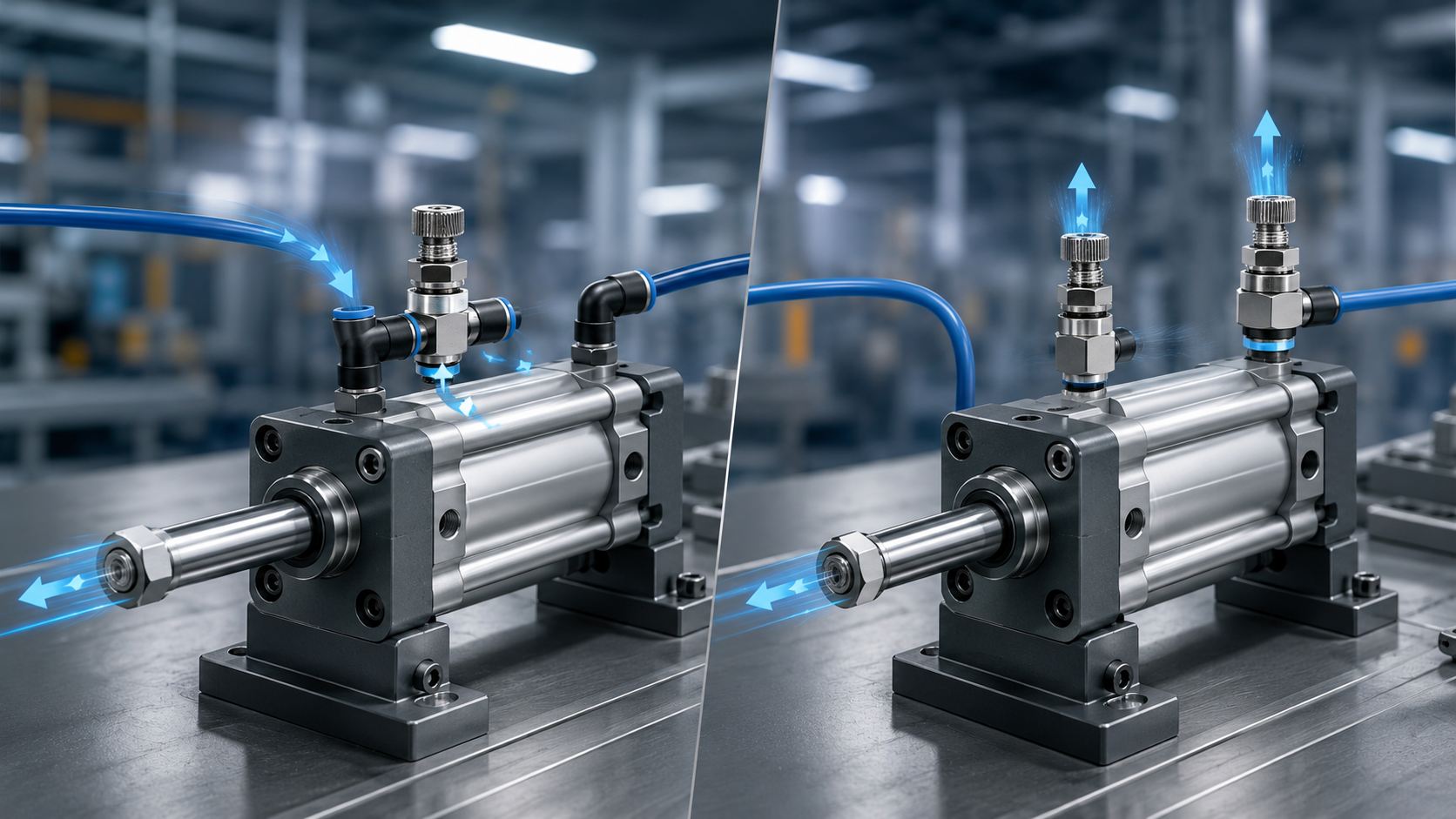
A pneumatic cylinder can have the correct bore, pressure, valve, and tubing yet still move too fast, hesitate near the end of stroke, or change speed when the load changes. In many cases, the missing part of the design is airflow control. Meter-in and meter-out control both restrict airflow, but they restrict different sides of the cylinder and therefore produce different motion characteristics. For automation engineers and OEM buyers, choosing between them should be based on load direction, cylinder behavior, required speed stability, tubing layout, and the flow-control fitting itself. The goal is not simply to slow a cylinder down; it is to make its movement predictable without creating unnecessary restriction elsewhere in the circuit.
What Is the Difference Between Meter-In and Meter-Out Cylinder Speed Control?
Both methods regulate cylinder speed by restricting airflow, but the restriction is placed on opposite sides of the actuator. Understanding that difference first makes product selection much easier.
How does meter-in control work?
Meter-in control restricts compressed air entering the cylinder chamber. Exhaust air is allowed to leave more freely.
This can work when the cylinder is moving against a reasonably stable resisting load. By limiting incoming airflow, the engineer limits how quickly the chamber fills and therefore controls piston speed.
The problem appears when the load itself tends to pull or push the cylinder in the direction of travel. In that situation, the actuator can move faster than the restricted supply air can control. Motion may become less stable because the load is effectively helping the piston move.
How does meter-out control work?
Meter-out control allows supply air into the cylinder relatively freely while restricting exhaust air leaving the opposite chamber. The trapped exhaust pressure creates resistance against piston movement.
That backpressure often gives more stable speed control when the load changes during the stroke. For this reason, meter-out arrangements are commonly considered for many double-acting pneumatic cylinder applications.
Neither method should be chosen only from habit. Cylinder orientation, load direction, valve arrangement, required response, and equipment safety all matter.
When Is Meter-Out Usually the Better Choice?
Many industrial automation systems use meter-out control because it gives the moving piston something to work against. That becomes particularly useful when machine loads are not perfectly constant.
Why does backpressure help stabilize motion?
Consider a horizontal cylinder moving a fixture. At the beginning of the stroke, friction may be relatively high. Once the fixture starts moving, resistance can fall. If only inlet air is restricted, that changing mechanical load can change cylinder speed.
With meter-out control, exhaust restriction maintains pressure on the opposite side of the piston. The cylinder has to push against that pressure as it moves, which can make motion easier to tune.
The same principle is useful where a load might assist cylinder movement, such as some vertical or angled installations. The exact circuit still needs an application-specific safety review; a flow controller is not a substitute for a load-holding device where uncontrolled movement could be hazardous.
Which equipment commonly benefits from stable speed control?
Packaging machinery, assembly stations, clamping devices, pick-and-place equipment, feeders, and other automated mechanisms often need repeatable motion rather than maximum possible cylinder speed.
When Can Meter-In Control Be Useful?
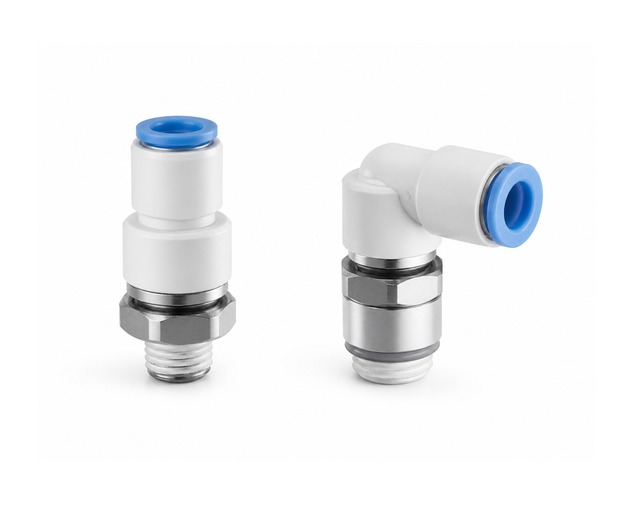
Meter-out is common, but that does not make meter-in wrong. The decision depends on what the load is doing and how the cylinder needs to respond.
When is an inlet restriction easier to control?
Meter-in can be useful where the cylinder always works against a resisting load and there is little risk of the load driving the piston ahead of the supplied air. Certain controlled pushing, pressing, or low-inertia motions may fit this condition.
It can also be useful in circuits where restricting inlet flow serves another process objective. However, the engineer should verify behavior across the full load range rather than setting the valve with an unloaded cylinder and assuming production will behave the same way.
What warning signs suggest meter-in is the wrong method?
Watch for sudden acceleration, inconsistent stroke speed, jerky movement, or large speed changes when the machine load changes. Those symptoms do not prove that the flow-control direction is wrong, but they are reasons to review it.
Before changing fittings, also check supply pressure, valve capacity, tubing length, tube ID, exhaust restrictions, and mechanical friction. A cylinder that moves slowly because its air path is undersized will not be fixed by opening a speed controller farther.
Buyers who are still defining the basic connection should first review How to Choose Push-to-Connect Pneumatic Fittings for Industrial Equipment so tube OD, thread, fitting geometry, and operating conditions are settled before the flow-control method is finalized.
How Should an AS-Type Speed Controller Be Selected and Installed?
Once the control method is decided, the fitting itself has to match the pneumatic circuit. A correct control principle combined with the wrong tube size or connection type can still restrict the machine unnecessarily.
Which connection details should be checked?
Start with tube OD and tube material. 폴리우레탄 공기 관 is widely used where flexible routing is needed, while PA or other pneumatic tubing may behave differently in terms of stiffness and pressure response.
Then verify the fitting connection. A speed controller may connect directly to a threaded cylinder or valve port, or it may be installed inline between two tube sections. Thread standard, tube size, installation clearance, and adjustment access should all appear on the drawing or purchasing specification.
The broader Fittings & Connectors range can help engineers compare elbow, inline, straight, and flow-control formats before freezing the machine layout.
Where should the flow controller be installed?
For cylinder speed control, placing the controller close to the actuator usually reduces the volume of tubing between the restriction and the cylinder chamber. This can make adjustment more direct and reduce the influence of a long intermediate air volume.
Installation should also leave enough access for commissioning. A knob that cannot be reached after guarding is installed creates an avoidable maintenance problem.
During setup, begin with a conservative flow setting and adjust gradually while observing the complete cylinder stroke. Test the machine with the real payload rather than only an empty mechanism.
What Should OEM Buyers Verify Before Approving a Speed Controller?
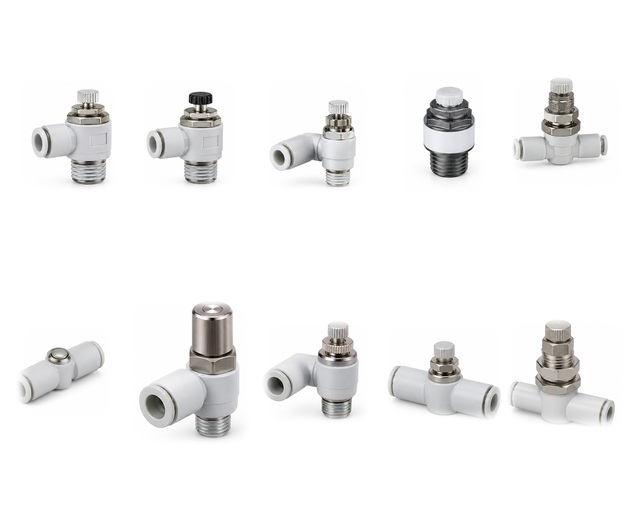
For repeat production, purchasing teams need more than a fitting that can slow one sample cylinder on a test bench. The approved product should fit the intended tube, port, installation envelope, and adjustment method consistently.
A practical approval checklist includes:
| 목 | What to Verify |
|---|---|
| Control direction | Meter-in, meter-out, or required flow-control arrangement |
| Tube | OD, material, and production-intent sample |
| 연결 | Thread or tube-to-tube configuration |
| Adjustment | Smooth, repeatable setting through usable range |
| Machine behavior | Stable cylinder motion with real load |
| Leakage | No unacceptable leakage at tube or thread interface |
| 설치 | Clearance for tube routing and adjustment |
| Repeat orders | Same model, materials, dimensions, and identification |
Do not approve a flow controller only because the cylinder eventually reaches the desired speed. Check whether the adjustment is stable after repeated cycling and whether one setting produces similar behavior across production-intent samples.
For purchasing, the RFQ should include cylinder application, tube OD and material, connection type, port thread if used, operating pressure, expected temperature, required quantity, and whether the project needs meter-in or meter-out control. If the control direction has not yet been determined, say so and provide the circuit information rather than asking the supplier to guess.
How Can AISILI Support Pneumatic Speed Control Projects?
Yantai Aisili 새로운 재료 Co., Ltd. focuses on polyurethane pneumatic tubing and related pneumatic materials for industrial automation. The company was established in 2007 and operates manufacturing facilities in Yantai and Linyi, Shandong, with seven extrusion production lines. Its product portfolio includes polyurethane tubing, multi-material pneumatic tubing, and fittings used in pneumatic connection and airflow-control applications. OEM 및 ODM support covers tubing dimensions, hardness, colors, and performance requirements. For machine builders and distributors evaluating speed-control fittings, project discussions can include tube OD, material, connection style, application conditions, and purchasing requirements so the fitting and tubing can be reviewed as one pneumatic interface rather than as unrelated components.
결론
Meter-in and meter-out controls both regulate airflow, but they do not control cylinder motion in the same way. Meter-out is often useful where changing loads require more stable motion, while meter-in can work where the cylinder consistently moves against a resisting load. The final decision should be tested with the real actuator, payload, tubing, valve, and operating pressure. Before volume purchasing, define the required control direction, connection format, tube size, installation space, and adjustment expectations, then qualify the speed controller on production-intent equipment rather than choosing only by series name.
자주 묻는 질문
1. Is meter-out always better than meter-in for pneumatic cylinders?
No. Meter-out is commonly used for stable cylinder motion, especially where loads vary, but meter-in can be appropriate when the actuator consistently works against a resisting load. Circuit behavior should be tested under real operating conditions.
2. Where should a pneumatic speed controller be installed?
It is commonly installed close to the cylinder or actuator port when controlling cylinder speed. The exact location depends on the circuit, connection type, available space, and whether inlet or exhaust flow is being controlled.
3. Can a speed controller fix an undersized pneumatic tube?
No. A flow-control fitting can restrict airflow, but it cannot create flow that an undersized tube, valve, or supply line cannot deliver. Check the complete air path if maximum cylinder speed is too low.
4. Can AS-type speed controllers be used with PU tubing?
The AS Type product family is intended for pneumatic tubing applications, but buyers should verify the applicable tube material and size for the exact model being ordered.
5. What should an OEM send when requesting a pneumatic speed-controller quote?
Provide the tube OD and material, connection or thread specification, cylinder application, operating pressure, temperature, required control direction, installation space, and expected order quantity.