


Push-to-Connect Fittings vs Threaded Fittings: Which Pneumatic Connection Is Better for Industrial Automation?
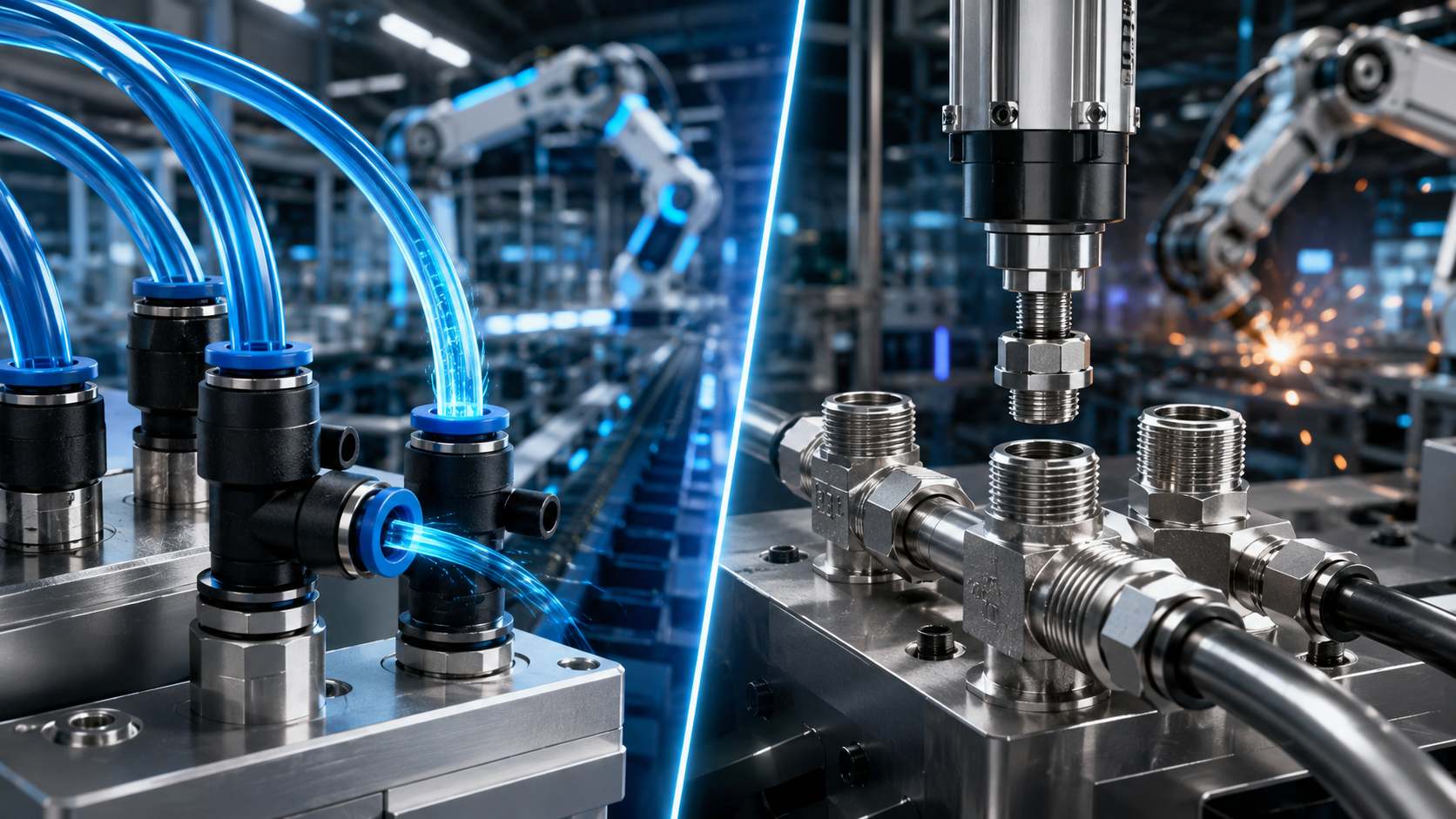
A pneumatic connection that leaks little can lead to slow cylinders, poor grips, frequent run time of the compressor, and challenging diagnostics. Push-to-connect fittings and threaded fittings each address some of these problems. The push-in design expedites the installation of tubes and their removal and replacement. Meanwhile, the threaded connection ensures a mechanical link at the valves, manifolds, cylinders, and other fittings. The choice between these solutions depends on pressure, vibrations, tubing material, temperature conditions, maintenance needs, exposure to chemicals, and the frequency of disconnecting. It is vital to consider the entire connection when choosing between push-in and threaded fittings and not to focus on the fitting itself.
Where Do Push-to-Connect and Threaded Fittings Behave Differently?
The distinction is easiest to see at the sealing point. A push-to-connect fitting seals around the outside of pneumatic tubing, usually with an internal O-ring, while a threaded fitting seals at the equipment port or between threaded components.
How Does a Push-to-Connect Fitting Hold the Tube?
The tube should go through the release collar, gripping ring, and seal. The gripping element ensures resistance to pullout, while the O-ring closes the space around the tube surface. It is essential to note that the installation is straightforward but require a square end, clean tube, and full insertion.
The compromised tube can lead to internal and external leakage that is not easily apparent until the system undergoes vibration and pressure. Thus, using a damaged tube end is a frequent cause of repair shop maintenance and the same error is repeated often.
What Makes a Threaded Joint Reliable?
Threads of fittings are dependent on correct type, engagement, sealing, and torque. Tapered threads are normally sealed by the interference of the threads with an approved sealant. Parallel threads may use an “O” ring or bonded washer, or a machined surface for a sealing action
Increasing the torque when connecting is not always good, because it may crack the plastic fitting, warp the manifold, or damage the threads. It is also vital not to overtighten a fitting, and leave it free to rotate, which may cause a leak at pressure.
Which Connection Is Better for Fast Installation and Maintenance?
Assembly speed strongly favors push-to-connect fittings when technicians are routing many tubes inside compact automation equipment. That advantage matters only if the fitting remains accessible and the tubing can be removed without damaging nearby components.
When Does Push-to-Connect Reduce Labor?
Machine builders can cut tubing to length, insert it without tools, and revise routing during commissioning. During service, a valve or cylinder line can often be disconnected without removing the fitting from the port.
This is useful in control cabinets, packaging machines, assembly stations, and robotic tooling with frequent component replacement. Tube labels and clear routing are still necessary; fast disconnection can create mistakes when several similar lines enter the same manifold.
When Is a Threaded Connection More Practical?
Threaded joints are often preferable where a component is intended to remain fixed, space is limited around the tube release collar, or the line uses rigid metal tubing, hose ends, or adapters. They also provide a stable interface for gauges, silencers, valves, and manifold accessories.
Maintenance takes longer because the joint may need tools, sealant cleanup, and renewed leak testing. Repeated removal can wear soft ports or leave sealant fragments inside the pneumatic circuit.
How Do Pressure, Vibration, and Environment Change the Decision?
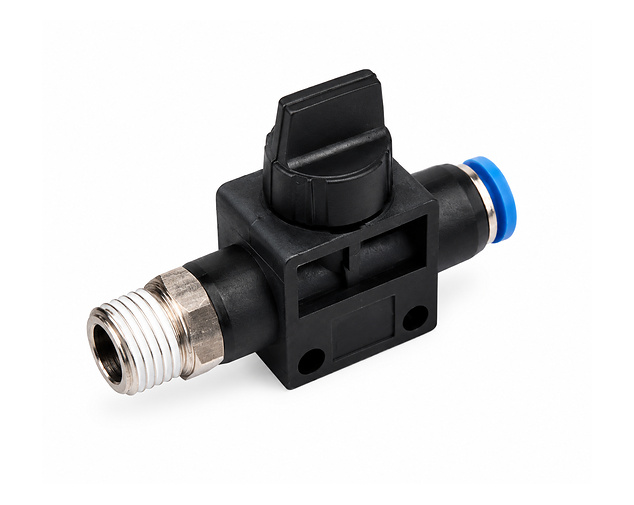
Catalog pressure ratings are only the starting point. Real installations include pressure pulses, machine vibration, moving cables, oil mist, washdown, heat, and tube side loads.
Which Design Handles Vibration and Motion Better?
A push-to-connect fitting performs well when the tube enters straight and has nearby support. Continuous side loading can work the tube against the seal or gripping ring. Excessively short runs transfer cylinder or valve movement directly into the fitting.
Threaded joints resist tube pullout at the port, but attached elbows or adapters can loosen if piping weight and vibration create leverage. In both cases, clamps and sensible routing often matter more than choosing one fitting style over the other.
What Should Be Checked for Temperature and Chemical Exposure?
Body material, seal compound, tube material, and thread sealant must be compatible with the environment. Tubing made of polyurethane, nylon, polyethylene, and PTFE varies in its pressure, flexibility, temperature resistance, and chemical resistance.
A brass fitting may be perfectly adequate in dry factory air but unsuitable in a harsh washing environment. A polymer body may decrease the fitting’s weight while also deforming closer to heat. Seal compatibility is critical to consider when a fitting is exposed to compressor oil, cleaning chemicals, and ambient temperatures.
What Failure Modes Should Engineers and Maintenance Teams Watch?
Most connection failures are not dramatic. They appear as intermittent leakage, creeping tube movement, cracked ports, restricted flow, or contamination introduced during repair.
Why Do Push-to-Connect Fittings Leak After Initially Working?
The common causes are improper tube preparation, improper insertion, improper seating of the collets, foreign material on the tube wall, side loading the fitting or using a tube that is out of diameter specifications. Tubes that have been in service for an extended period of time can permanently set or harden.
Back off the tube until you see good, clean metal, check the fitting, and reinsert the tube. Pulling on the tube to remove can permanently scar the tube surface and cause improper seating of the tube within the fitting by pulling out the release collar.
Why Do Threaded Fittings Crack or Loosen?
Cracking often begins with excessive tightening, mismatched threads, or installing a metal fitting into a weak plastic port. Loosening can follow vibration, thermal cycling, poor thread engagement, or unsupported piping.
Mixed thread standards deserve close attention. NPT, BSPT, BSPP, and metric threads may appear similar at a glance but seal differently. Forcing an incorrect combination can damage both parts while creating a joint that cannot be inspected reliably.
How Should Buyers Compare Fittings and Suppliers for Automation Projects?
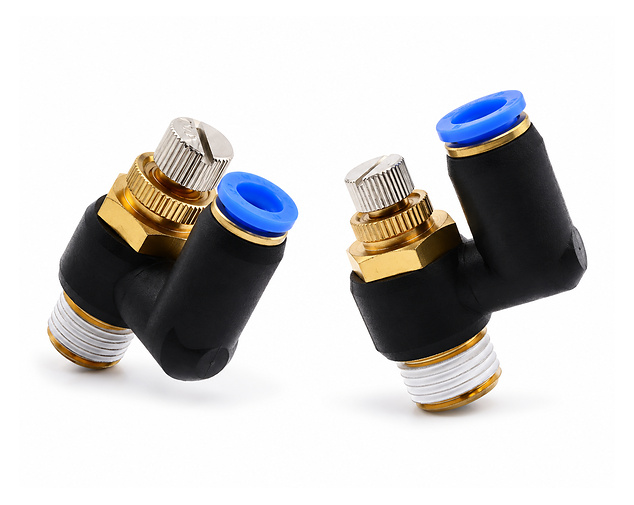
A useful comparison goes beyond fitting shape and unit price. Buyers need the exact tube range, thread standard, pressure and temperature limits, seal material, flow path, and inspection method.
What Should Be Verified on Samples?
Check thread dimensions, tube insertion depth, release-collar movement, gripping force, seal condition, body finish, and internal cleanliness. Assemble the sample with the intended tubing and port, then test for leakage, pullout, rotation, and pressure cycling.
Flow restriction also matters. Compact elbows, speed controllers, and reducers can create pressure drop that slows actuators. Compare internal passages when the circuit has high flow demand or rapid cycling.
Which Controls Reduce Repeat-Order Problems?
Approved specifications should identify body material, thread form, seal compound, gripping element, tubing range, working pressure, temperature range, and packaging. Lot markings and retained samples help when a field complaint appears months later.
Changes to resin, plating, O-rings, thread tooling, or internal geometry should require notification. A fitting that looks unchanged may behave differently if seal hardness or gripping-ring geometry has been altered.
How Can a Pneumatic Fitting Supplier Support Connection Selection?
Yantai Aisili New Material Co., Ltd. supplies push-to-connect fittings for pneumatic systems used in industrial automation. A project inquiry can include tube material, outside diameter, working pressure, temperature, thread standard, port material, media, vibration, chemical exposure, and installation space. Samples should be checked for insertion depth, tube retention, release action, leakage, flow restriction, and compatibility with the intended tubing. Quotations should identify body and seal materials, dimensional limits, packaging, lead time, and inspection points. Before volume production, buyers should approve drawings, physical samples, acceptance criteria, labeling, formal change-notification requirements, and incoming inspection plans for receiving teams.
Conclusão
Push-to-connect fittings are generally more efficient for flexible pneumatic tubing, space-saving machine assembly, and frequent maintenance. Threaded fittings, however, are still necessary for fixed machine ports, rigid connections, instrumentation, and applications that require a mechanical joint. The proper fitting type cannot be chosen without considering threads, tube preparation, materials, support, and leak-testing. Therefore, it is essential to focus on the load and conditions at every connection rather than try to standardize the whole automation system around one fitting type.
Perguntas frequentes
1. Are Push-to-Connect Fittings Reliable for Industrial Automation?
Yes, when the tube material, diameter, pressure, temperature, and environment match the fitting. Square cuts, full insertion, clean surfaces, and proper tube support are essential for reliable sealing.
2. Do Threaded Fittings Handle Higher Pressure Than Push-to-Connect Fittings?
Sometimes, but not automatically. Pressure capability depends on body material, thread design, port strength, seal method, tube rating, temperature, and the manufacturer’s specified operating limits.
3. Why Does Pneumatic Tubing Pull Out of a Push-to-Connect Fitting?
Common causes include incomplete insertion, damaged tubing, incorrect outside diameter, worn gripping teeth, excessive side load, high temperature, pressure above the approved range, or unsuitable ambient conditions.
4. Can NPT and BSP Threads Be Connected Together?
They should not be treated as interchangeable. Thread angle, pitch, taper, and sealing method differ, so forcing them together can damage the port and produce unreliable sealing.
5. Which Connection Is Easier to Maintain on Automated Equipment?
Push-to-connect fittings are usually faster for tube removal and replacement. Threaded fittings may be preferable where the joint stays fixed or where tube-release access is restricted.