


How to Size Reducing Push-to-Connect Fittings Without Creating Unnecessary Pressure Drop
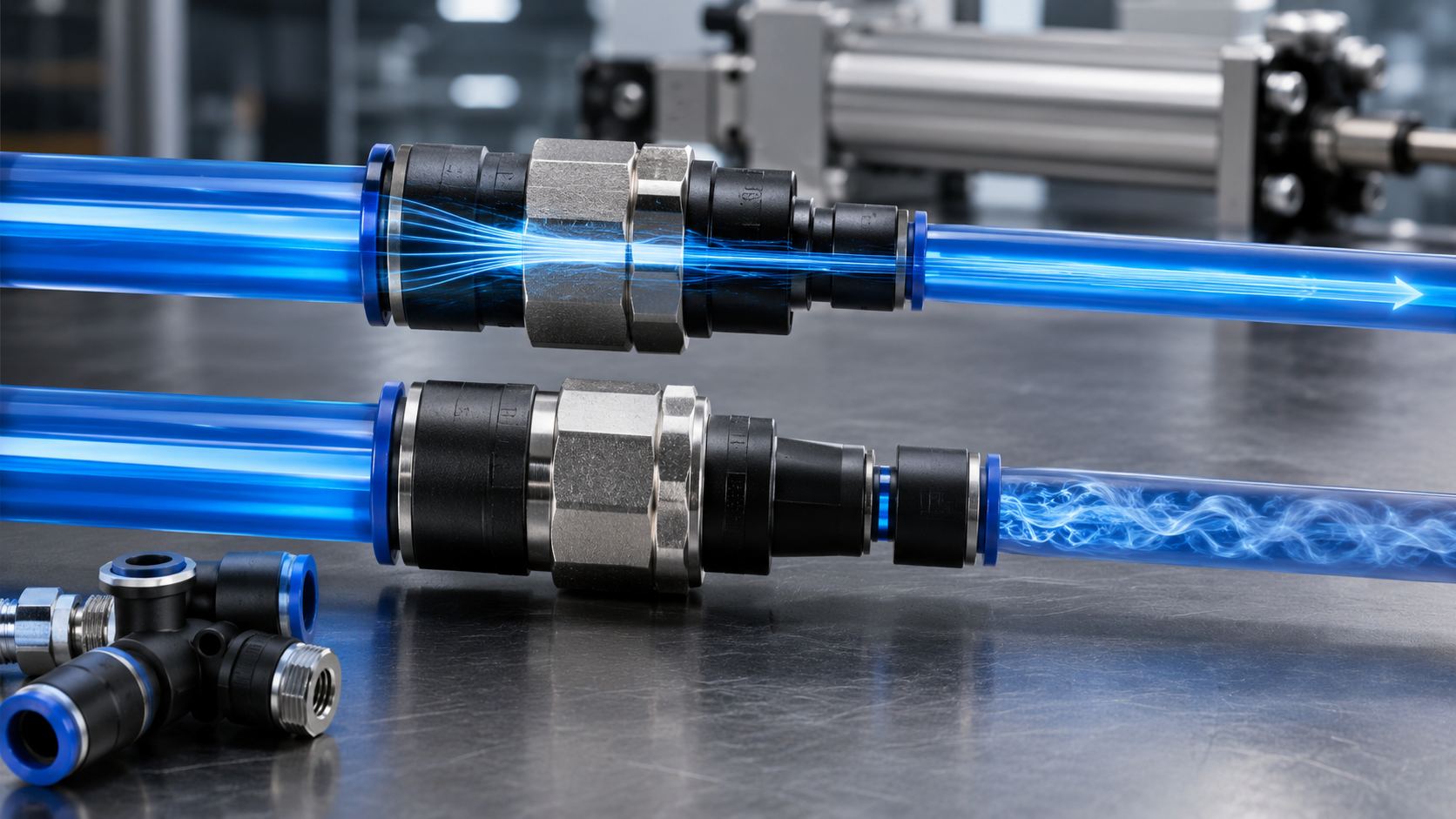
Reducing push-to-connect fittings solve a common pneumatic design problem: one part of a machine needs a smaller tube than the main air line. The mistake is assuming that any reducer with the correct two outside diameters will perform the same way. Reducing tube size changes the available flow area, and the location of that reduction can influence pressure drop, cylinder response, filling time, and future maintenance. For machine builders and B2B buyers, a reducer should therefore be selected as part of the complete air path. The useful question is not only “Will an 8 mm tube connect to a 6 mm tube?” but “Is 6 mm still large enough for the downstream airflow requirement?”
Why Can a Reducing Fitting Affect Pneumatic System Performance?
A reducer itself does not automatically create a performance problem. The issue is that it marks the point where the pneumatic line becomes smaller.
When air flows through a smaller passage, velocity generally increases for the same required flow, while resistance to flow can become more significant. The actual pressure loss depends on the complete path: tube ID, length, fitting geometry, valve passages, bends, flow demand, and operating pressure.
Why is tube OD alone not enough?
Push-to-connect fittings are selected by tube OD, but airflow occurs through the tube ID. Two products with the same OD can have different wall thicknesses and therefore different internal flow areas.
That distinction matters when a designer reduces a main distribution line to a smaller branch near a cylinder. The smaller branch may be perfectly adequate for a low-flow actuator but restrictive for a large cylinder that needs to fill quickly.
This is why the reducer should be selected after estimating downstream air demand, not before.
Does one reducer cause all the pressure drop?
Usually not. A pneumatic circuit accumulates restrictions. Long small-diameter tubing, compact valves, elbows, silencers, flow controllers, and fittings can all contribute.
A reducer may be acceptable by itself but become important when it is added to an already restrictive path. If an actuator is slower than expected, look at the entire supply and exhaust route before blaming the connector alone.
How Should Engineers Choose the Two Tube Sizes on a Reducing Union?
The upstream and downstream tube sizes should reflect their jobs in the circuit. A larger main line can carry air to several branches, while a smaller branch may be sufficient for a nearby actuator or control component.
Where should the line normally be reduced?
If a smaller tube is required only near one actuator, it often makes sense to keep the larger tube for most of the run and reduce closer to the point of use. This avoids forcing the entire upstream path to operate through the smaller diameter.
That is not a universal rule. Machine layout, response time, tubing volume, cost, and available space can change the preferred arrangement. The key is to avoid downsizing much earlier than the application requires.
What information should be checked before choosing the smaller side?
Consider downstream cylinder size, required cycle speed, tube length, valve flow capacity, simultaneous air demand, and acceptable response.
If several actuators share the same branch, the peak combined requirement matters more than the average flow of one cylinder.
Where the design is uncertain, test the proposed tube sizes under the real cycle. A bench connection that holds pressure does not prove the line can supply enough air during rapid repeated movement.
When Is a Reducing Union Better Than Using Multiple Adapters?
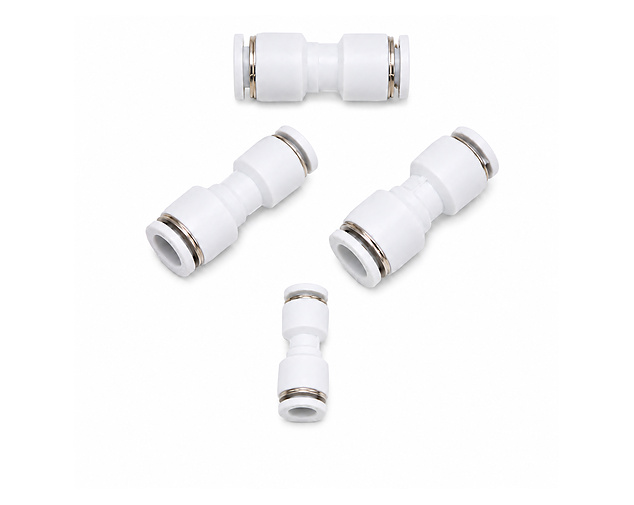
A direct reducing union can simplify a circuit when the only job is to connect two tubing ODs in the same direction. Fewer interfaces generally make the layout easier to assemble and inspect.
What problems can extra adapters create?
Using a same-size union, short tube section, threaded reducer, and another fitting may achieve the same dimensional transition, but it also introduces more parts, more sealing interfaces, and more installation space.
That does not mean an integrated reducer is always the right answer. Threaded adapters may still be needed where a component port changes size or where rigid hardware must be supported.
For a simple tube-to-tube transition, however, a purpose-designed reducer can make the bill of materials easier to manage.
The wider Fittings & Connectors range can be used to compare straight, elbow, union, bulkhead, and flow-control configurations before deciding whether a reducer is really the shortest and cleanest connection.
When should the designer avoid reducing tube size?
Do not reduce a line simply because the smaller tube is cheaper or easier to route. If the downstream component requires high instantaneous airflow, a smaller tube may increase filling or exhausting time enough to affect machine cycle performance.
A compact machine can also tempt designers to use a small tube everywhere. Before making that trade-off, compare routing convenience against response requirements.
How Do Tube Material and Installation Affect a Reducing Fitting?
The two tubes may have different diameters, but both still have to meet the fitting’s material and dimensional requirements.
Can PU and nylon behave differently in the same reducer?
Yes. Tubos pneumáticos de poliuretano is relatively flexible, while nylon tubing is generally stiffer. The gripping and sealing system must work with the actual tube material and OD.
If the machine uses multiple tube materials, do not assume that successful testing with one automatically approves the other. The Multi-Material Pneumatic Tubing range includes different material families with different mechanical behavior, so production-intent combinations should be checked separately.
What installation details matter most?
Both tube ends should be cut squarely and inserted fully. Because a reducer has different port sizes, installers also need clear identification of which tube belongs on each side.
Routing should remain straight enough near the fitting to avoid continuous side load. A reducer is not intended to act as a structural support for a heavy or poorly routed tube run.
Before disassembly, depressurize the circuit. If a tube end has been deeply marked or damaged from previous use, trim it back to a clean sealing surface before reconnecting.
What Should OEM Buyers Test Before Approving a Reducing Fitting?
A volume order should be approved against the real pneumatic requirement, not only dimensional fit.
A useful qualification plan checks both connection integrity and system behavior:
| Check | What to Review |
|---|---|
| Tube sizes | Correct OD on both sides |
| Tube materials | Approved production tubing |
| Flow requirement | Downstream actuator demand |
| Pressure behavior | Supply pressure during actual cycle |
| Conexão | Full insertion and secure retention |
| Leakage | Both tube interfaces |
| Routing | No severe side load |
| Repeat orders | Dimensions and material consistency |
If cylinder response changes after downsizing, compare the system with the larger tube temporarily restored. This A/B check can help determine whether the restriction comes from the reduced branch or somewhere else.
Buyers should also separate a fitting problem from a sizing problem. A reducer can be perfectly manufactured and still be the wrong size for the machine.
For projects that have not yet fixed tube OD, fitting style, and application conditions, How to Choose Push-to-Connect Pneumatic Fittings for Industrial Equipment provides a broader selection framework before the reducer specification is finalized.
How Can AISILI Support Pneumatic Tube Sizing and Fitting Selection?
Yantai Aisili New Material Co., Ltd. develops and manufactures polyurethane pneumatic tubing and related pneumatic materials for industrial automation applications. Established in 2007, the company operates manufacturing facilities in Yantai and Linyi, Shandong, with seven extrusion production lines. Its portfolio includes polyurethane tubing, multi-material pneumatic tubing, and fittings used to connect different tube sizes and machine components. OEM and ODM support covers tubing dimensions, hardness, colors, and performance requirements. For equipment builders, distributors, and industrial buyers evaluating reducers, AISILI can review tube OD, material, fitting configuration, operating conditions, and purchasing requirements together so the transition between two tube sizes is qualified as part of the pneumatic circuit rather than as an isolated connector.
Conclusão
A reducing push-to-connect fitting should be chosen by more than its two tube ODs. Engineers need to confirm that the smaller downstream tube still provides the airflow required by the actuator, while buyers need to verify tube material, fitting compatibility, installation, and repeat-order consistency. Keeping a larger line where high flow is needed and reducing only where the smaller branch is justified can help avoid unnecessary restriction. Before volume purchasing, test the proposed reducer with the real tubes, valve, actuator, cycle time, and operating pressure so dimensional convenience does not come at the expense of machine response.
Perguntas frequentes
1. Does a reducing push-to-connect fitting always cause a large pressure drop?
No. The effect depends on the complete system, including the two tube IDs, tube lengths, airflow demand, valves, bends, and other restrictions. The reducer should be evaluated as part of the full air path.
2. What does PG8-6 mean on a reducing pneumatic fitting?
On AISILI’s PG Series example, PG8-6 indicates an 8 mm tube connection on one side and a 6 mm tube connection on the other. Buyers should verify the exact size table for the required model.
3. Should the smaller tube be installed near the cylinder?
Often, keeping the larger line for most of the run and reducing near the point of use can limit unnecessary restriction, but the best arrangement depends on airflow demand, tube length, machine layout, and response requirements.
4. Can one reducing fitting connect PU tubing to nylon tubing?
Only if the specific fitting permits both tube materials and each port matches the correct OD. The combination should be tested with the actual production tubes before approval.
5. What should buyers include in an RFQ for reducing push-to-connect fittings?
Provide both tube ODs, tube materials, expected airflow or actuator application, operating pressure and temperature, required quantity, installation constraints, and any inspection or packaging requirements.