


How to Route Pneumatic Tubing Through a Control Cabinet Panel
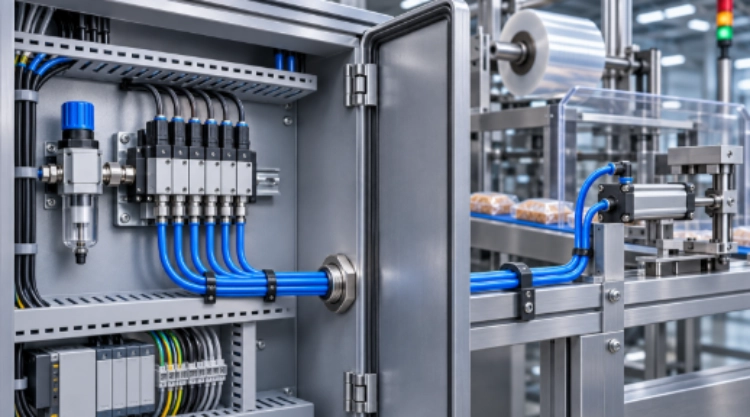
At a packaging machine, the valve manifold may sit in a side cabinet while a cylinder works outside on the frame. One tube joins them through the wall. Scrape the exposed end during a changeover and the repair crew may have to undo ties inside the cabinet as well. There is no separate “outside length” to replace.
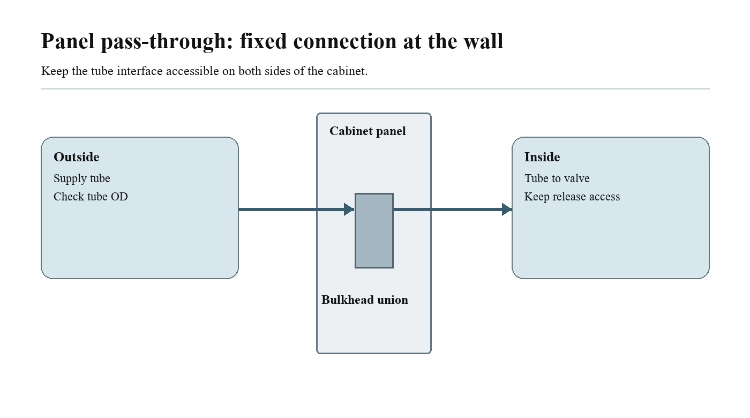
A bulkhead fitting gives the run a break at the sheet metal: one length goes to the cylinder, another to the manifold. Decide its position while laying out the cabinet. A nut tucked behind a wire duct might be reachable during assembly, then impossible to get at once the rest of the wiring is in place.
Aisili’s PU tube goes into automation lines, packaging machinery and automotive production. The range also serves pneumatic tools and food-processing machinery. The panel detail here is useful wherever a machine splits its air circuit between a cabinet and moving equipment.
Give the tube a fixed crossing point
Why an open hole is a poor long-term connection
An edge grommet protects the tube, and on a trial fixture that may be enough. It does not anchor the run. Pull the cylinder-side tube and that load can reach the manifold connector. If the line moves with the machine, the wall can become its wear point. Use a fixed crossing when the two sides need to be serviced separately.
The cabinet seal is another detail. A bulkhead provides an air connection at the panel; it does not automatically preserve a dust or washdown rating. If the enclosure has an ingress requirement, the drawing must deal with the opening around the fitting body too.
Match the two interfaces, not just the hole
If both ends of the crossing are tubing, the PMM brass bulkhead union has two push-in ports and a threaded centre held by a locknut. Its stated tube choices are PU and nylon. The PMF bulkhead female connector puts a female pipe connection on one side instead. That difference decides what can be connected inside the box.
The PMM mounting thread is easy to mistake for part of the air circuit when all the buyer has is a product photo. It carries the locknut, not another air connection. Mark the panel cutout and the two working ends on the drawing. For PMF, add the thread form of the part that screws into the female side, along with enough clearance to install that part without hitting a duct or door frame.
Specify the tube before drilling
Start with outside diameter and the actual fitting
Suppose the manifold line on that machine is called “5 × 8 PU.” At Aisili that means a 5 mm bore and 8 mm outside diameter, with a nominal 1.5 mm wall. The bulkhead’s push-in ports must match the 8 mm outside, even though the bore is also part of the circuit design. Writing only “8 mm” on the purchase order invites confusion at the next service visit, when the original supplier label may no longer be to hand.
Keep a short piece of the approved tube with the fitting sample. The tube’s end has to be round, clean and square if it is going to seat well; an old offcut flattened by pliers tells little about the intended fit. Aisili offers several inner and outer diameters, colours and cut lengths as well as related push-in connectors. Put the agreed tube and connector codes on one build record, so a later order is for the combination that was checked, not two parts selected independently by nominal size.
One cabinet might use a straight cut length throughout; another needs a coil at the moving end. Aisili sells straight, coiled and spiral PU tube, so name the form on the drawing. Tube dimensions, hardness, colour and performance can be specified for OEM/ODM supply. If a replacement purchase order says only “blue PU,” the buyer cannot recover the bore, wall or hardness from that description.
Select material for the route on both sides
On the manifold side, that 5 × 8 tube may hardly move. Near the cylinder it could brush a guard or see cleaning spray. Buy for that outside section too. Ester-based PU tubing can work for a flexible compressed-air run with occasional oil or surface wear. If moisture is persistent, compare an ether-based tube. Neither material name tells you how it will handle an unidentified cleaner. Put the exposure and operating temperature on the specification.
Aisili’s general PU tube range is intended for compressed air, ordinary industrial water and non-corrosive oils. That does not establish whether a washdown cleaner is safe on the outside of the tube. Name the cleaner before approving the material for an exposed run.
Aisili PU tube is flexible and light, with a smooth surface and resistance to abrasion and oil. A guard can still wear through a line if the two keep touching. Temperature changes the pressure decision too: a hotter run may need a lower working pressure. Heat, corrosive chemicals and damp storage can all shorten tube life. If the cylinder end gets washed every shift, that detail belongs in the material choice.
For a quotation, mark pressure, temperature, movement and possible surface contact on the route sketch. If two materials meet at the bulkhead, approve the fit at both ports.
Draw a serviceable route on each side
Leave room for the fitting and the technician
Place the penetration where the inside tube can withdraw straight from its collar, with the wire duct cover in position. Leave a tool path to the nut. If the line has to turn near the panel, move the hole or turn it at an accessible elbow. The KJ mini push-to-connect range offers compact panel and elbow styles; specify the actual port and thread for the chosen model.
Aisili uses resilient TPU for its PU tubing, which helps keep the bend radius small. There is still a bad place for the turn: right at the push-in collar. Give the tube a short straight approach, then bend it where a clip can hold it and a technician can see it.
Identify the lines before they disappear behind the panel
A colour scheme is useful when several lines cross one panel. Aisili can make tubing in OEM colours, yet the circuit still needs labels: the maintenance store might issue a replacement in a different colour. Put the valve or cylinder reference on both sides, away from the length that enters the fitting. That little bit of space avoids a tag caught under a release ring.
Transparent tubing allows a visual check along the line, though clean compressed air is invisible. Visible moisture or contamination is easier to spot through a clear wall. Coloured tube serves a different job: line identification. Aisili makes coloured tube with weather-resistant pigment to limit fading in service. Its black and transparent tubes have the same softness; for colder conditions, a softer tube can be ordered separately. Write down that choice. The blue tube on an old cabinet may carry no clue about the hardness that was originally specified.
Mark support points on the drawing and allow a little length for a later recut. Keep the loop clear of hinges and hot covers.
Install, pressurize, and inspect
Secure the body before connecting either tube
Before cutting metal, isolate the machine and release stored air under the site’s procedure. Check the panel thickness and the fitting body, then cut and deburr the opening. The nut must secure the body without the tubing acting as a brace. Use the tightening instructions for that fitting, not a torque copied from another connector.
Cut the tube square, clear away swarf, and inspect the surface that will enter the seal. Recut a crushed or scored end. Insert it fully, give it a light retention pull, and check the angle of approach. Sideways tension at the port means the route still needs work.
Test the installed circuit, not an isolated sample alone
Restore pressure gradually and inspect both joints. If cycling is safe, watch the external run while the machine moves; rubbing may disappear when it stops. For a multi-line panel, trace each tube to its valve or cylinder against the circuit drawing before closing the door.
For a repeat cabinet build, Aisili’s production setup is relevant: Yantai and Linyi bases, seven extrusion lines, incoming materials checked against 16 physical and chemical criteria, and tube diameter monitored during extrusion. The online diameter-control tolerance is ±0.12 mm. The material controls cover burst pressure, hydrolysis, weathering, flexibility, bend radius and insertion and withdrawal force. Even with those checks, keep the accepted tube offcut, fitting code and route drawing for the machine being built.
Avoid four repeat failures
Air noise at the push-in port? Compare tube OD with the port, then examine the end and its insertion. The panel nut will not fix a tube seal. For a rubbing line, find the contact point while the machine moves; reposition the support if possible. If the body itself turns during tube removal, check the nut and the panel thickness.
Wrong valve, wrong motion: trace the line through the cabinet wall and correct both labels and the drawing. A slow actuator is less specific. It could involve the valve, regulator, a restriction or a leak away from the bulkhead, so test one circuit section before replacing the cabinet’s tubing.
Keep the approved combination on the build record
The replacement record needs a fitting code, panel thickness and cutout, tube OD and bore, material, colour, cut lengths, and both mating connections. Keep the approved sample and drawing revision with it. “Bulkhead, 8 mm” leaves too much to guess.
Aisili keeps standard tube specifications in stock and takes customised orders. For a production line with repeat cabinets, separate the stocked maintenance item from any OEM tube specified by colour, dimensions or hardness. A warehouse substitution can otherwise undo the choice made for the first build.
Aisili accepts batch orders and OEM/ODM work with flexible minimum order quantities. Count the tube needed across the next group of cabinets before ordering a custom colour or hardness; the fitting and cut length may differ between machines.
For an Aisili tube-and-fitting quote, send the cabinet sketch, both mating connections and operating conditions through the contact page. Include the required tube dimensions, hardness and colour. A photo helps on replacement jobs, where an existing wire duct or hinge can limit access to the panel nut.