


How to Choose a Pneumatic Hand Valve for Local Machine Isolation and Maintenance
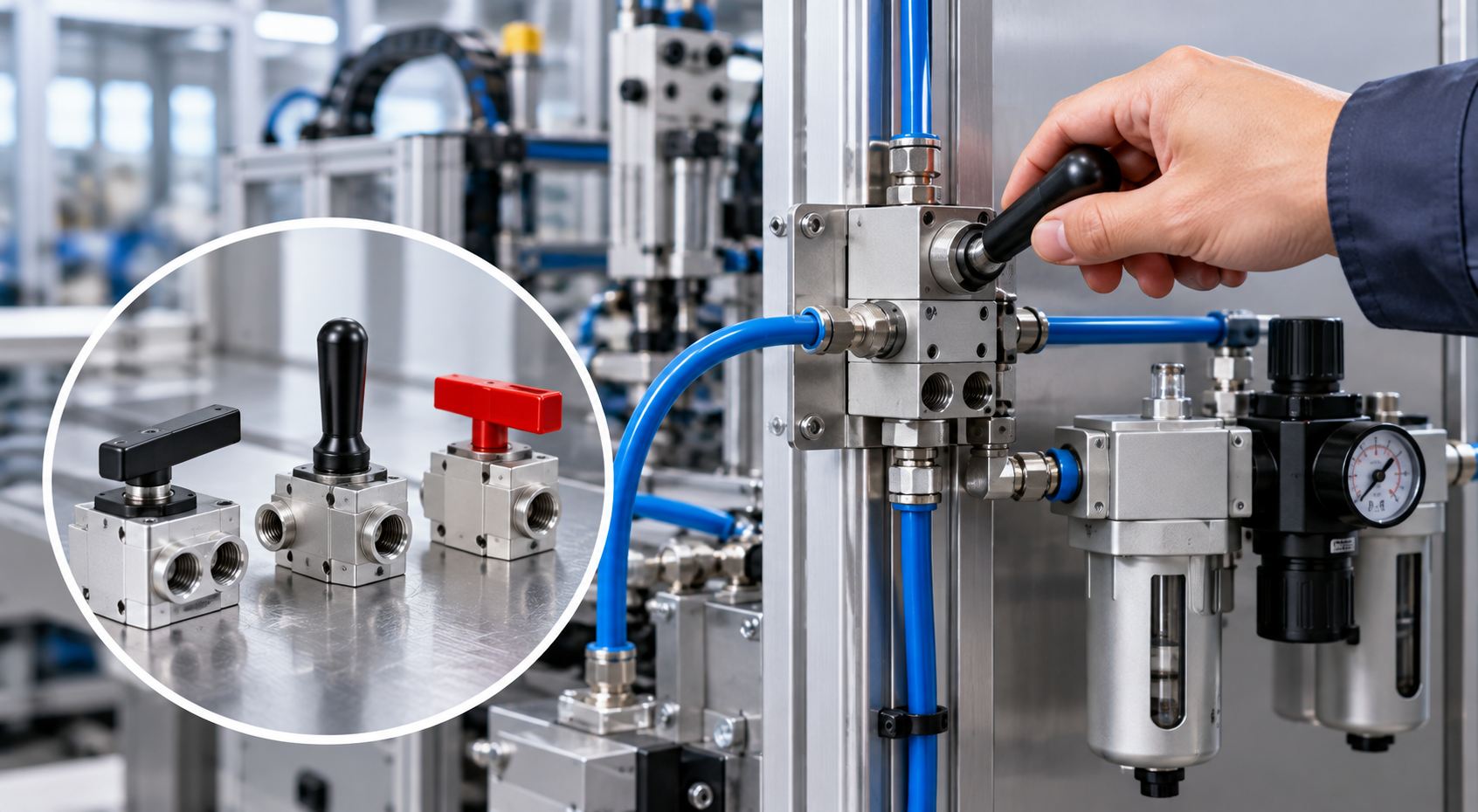
A pneumatic hand valve is useful when a machine needs local airflow shutoff for setup or service, but selection should begin with the isolation task rather than the valve shape. Buyers need to know whether the line only needs on/off control, whether downstream pressure must be released after shutoff, where the operator will reach the valve, and which tube size and material are fixed in the machine. Those details affect function, installation, service access, and repeat-order consistency. This guide covers the decisions an OEM or factory buyer should settle before approving an inline pneumatic hand valve.
What Isolation Function Does the Machine Actually Need?
The first decision is functional. An on/off valve can stop new compressed air from entering a branch, but a closed branch may still contain stored pressure. That difference matters during tooling changes, fixture adjustment, and fault finding near pneumatic actuators.
Is shutoff alone enough for the task?
For temporary airflow interruption, a simple manual shutoff may be adequate. If maintenance also requires residual pressure to be exhausted, specify that separately. Do not assume every hand valve vents the outlet; some arrangements provide an exhaust function, while others are strictly two-port on/off devices.
Where does local isolation add practical value?
Local isolation is useful when one machine station needs attention without interrupting a wider air network. Assembly jigs, packaging stations, test benches, and compact control panels are common examples. Buyers can use the 피팅 &연결관 category to map shutoff, branch, and connection functions before freezing the bill of materials.
How Should Valve Location and Operator Access Be Planned?
A hand valve is only useful when an operator can reach it without pulling tubing, removing unrelated hardware, or working around moving equipment. Placement therefore deserves the same attention as connection size.
Should the valve be mounted close to the work area?
Place the valve where maintenance personnel can identify and operate it easily. The shortest tube route is not always the best location; visibility, access, routing, and mounting stability matter more. A supported valve also limits twisting of nearby tubing during repeated operation.
What should be checked around the installed valve?
Leave enough straight tube for insertion and future removal. Avoid a sharp bend beside a push-in port, and keep the release mechanism accessible. If the layout uses flexible 폴리우레탄 공압 튜브, check that routing does not leave constant side load on the valve body.
A physical mock-up is often better than CAD alone for checking whether a technician can reach the control and disconnect the line during service.
Which Tube and Connection Details Must Be Fixed Before Ordering?
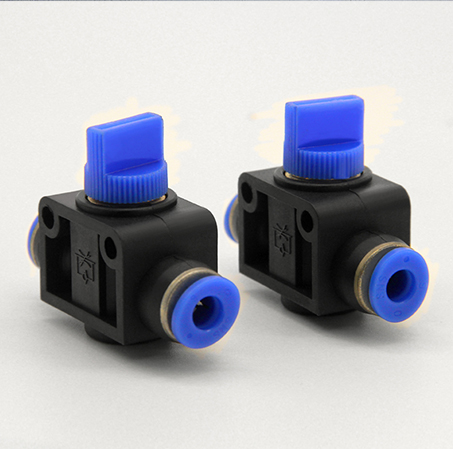
Once function and location are clear, the connection specification becomes simpler. Inline hand valves can avoid threaded adapters when both sides connect directly to tubing, but the ports still have to match the production tube exactly.
Why must tube OD and material be specified together?
Push-to-connect ports grip and seal on the tube outside surface, so the RFQ should state exact tube OD. Metric and inch tubing that look similar should not be substituted without dimensional confirmation.
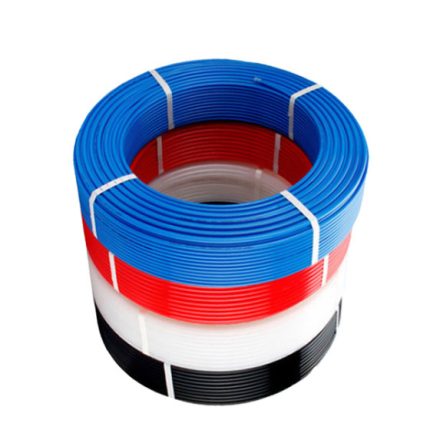
Tube material belongs in the same specification because PU and nylon differ in stiffness and handling. Projects using several materials can review 다중 재질 공압 튜브 options and test each approved combination separately.
The purchase order should also state the tube OD at both valve ports. Equal-size inline connections are common, but relying on a product-family name or photograph creates unnecessary ambiguity.
What Should Buyers Test Before Approving a Pneumatic Hand Valve?
Sample approval should confirm both the required isolation function and the reliability of the tube connection during repeated operation.
What belongs in the functional test?
Operate the valve repeatedly in the intended circuit. Confirm clear open and closed positions and verify the downstream behavior. If venting is required, check that the selected arrangement actually relieves the downstream line. Pressure and temperature limits must come from approved data for the exact model.
Use production-intent tubing to check insertion, retention, release action, and leakage at both ports. Include the planned mounting arrangement in the sample evaluation.
| Check | Buyer Acceptance Point |
|---|---|
| Valve function | Required shutoff or venting behavior confirmed |
| Tube interface | Correct OD and approved tube material |
| Operation | Manual control is consistent and accessible |
| Retention | Tube remains secure during repeated operation |
| Leakage | Both connection sides checked |
| 설치 | Routing and mounting do not load nearby tubing |
For repeat OEM production, record the approved sizes, function, mounting arrangement, and identification so later batches can be checked against the same baseline.
What Information Should a Purchasing Team Put in the RFQ?
A useful RFQ should describe the operating requirement first, followed by connection, installation, and commercial details.
State the required on/off behavior, whether residual-pressure venting is needed, tube OD on each side, tube material, mounting space, working medium, operating conditions, quantity, and any drawing, marking, packaging, or inspection requirements. For replacement sourcing, include the original part number, a dimensioned sample, or an installation drawing.
The RFQ should describe the service location because a control-panel valve may have different access needs from one beside an assembly fixture. Reviewing the broader pneumatic component catalog can help align the valve with neighboring tubing and connection hardware.
Need Support Matching Pneumatic Hand Valves to Machine Isolation Requirements?
Yantai Aisili 새로운 재료 Co., Ltd. was established in 2007 and operates manufacturing facilities in Yantai and Linyi, Shandong, with seven extrusion production lines for polyurethane pneumatic tubing and related materials. Its OEM/ODM support covers tubing dimensions, hardness, colors, and performance requirements, allowing tube and fitting specifications to be reviewed together. For local air-isolation layouts, the HVFF 시리즈 유니온 직선형 푸시투커넥트 공압식 수동 밸브 uses push-to-connect tube ports on both sides without a pipe thread and is listed for PU and nylon tube. Buyers should confirm tube OD, valve function, mounting arrangement, operating conditions, and sample checks before production approval.
결론
A pneumatic hand valve should be specified around the maintenance task, not selected only by size or appearance. Buyers need to distinguish simple shutoff from downstream venting, place the valve where it can be operated without stressing tubing, and qualify the connection with production-intent materials. Before volume ordering, confirm function, sizes, access, mounting, operating conditions, and repeat-order identification so the approved component remains consistent with the machine design.
자주 묻는 질문
1. What is the difference between a pneumatic hand valve and a flow controller?
A hand valve mainly opens or shuts an air path, while a flow controller regulates airflow and actuator speed. Define the required circuit function before comparing components because the two devices solve different operating problems and should not be treated as interchangeable.
2. Does every pneumatic hand valve release downstream pressure when closed?
No. Some arrangements are simple two-port shutoff valves, while other versions may provide venting. If residual pressure must be released for maintenance, state that requirement explicitly and verify the function on the exact sample being approved.
3. Which tubing details are needed when ordering an inline hand valve?
Specify the outside diameter on both sides and the tube material, such as PU or nylon. If the machine uses metric and inch components, identify the measurement system clearly to prevent a visually similar but dimensionally different tube from being substituted.
4. Where should a manual pneumatic isolation valve be installed?
Choose a location that is visible, reachable, and compatible with clean tube routing. The operator should be able to use the valve without pulling on tubing, while maintenance staff should still have practical access to the connection and release mechanisms.
5. What should be included in a hand-valve sample approval test?
Confirm shutoff or venting behavior, tube fit, retention, release action, leakage, manual operation, and mounting. The test should use production-intent tubing and realistic operating conditions rather than a convenient workshop tube that may behave differently.