


How to Diagnose Reverse Flow in a Pneumatic Air Circuit
A carton stop on a conveyor is meant to stay extended after the supply is shut. At the next shift it has crept back. There is a small check valve in the cabinet, so it gets named in the maintenance book. Yet the cylinder line also has a push-in joint beside the guard and a directional valve with an exhaust port. Either could empty the trapped side without air going backward through the check valve.
I would leave the spanner in the drawer for a moment. Which pocket should still hold air? Mark that pocket and the valve on the machine sketch.

Recognize a reverse-flow symptom before blaming the valve
Return pressure should close the check valve against its arrow. It does not set cylinder speed or isolate the machine for service. On the carton stop, a drifting rod tells us the cylinder is no longer held as expected. It says nothing yet about which exit the air took.
Was the cylinder extended when it began to move? Ask whether the tube or connector was changed during the last changeover. Those details are easy to lose once the guard comes off. I would put them on the work order before touching the line. The drawing in the cabinet may also predate a repair.
Compare trapped pressure with ordinary external leakage
At the carton stop, look first at the exposed tube. It may brush a guard or get pulled sideways during an adjustment. Check the contact mark and the few millimeters entering the fitting. Use the plant’s approved method on the joint. A quiet leak can still drain a small cylinder overnight.
PU pneumatic tube is flexible and resists abrasion, but repeated rubbing can score it. A push-in fitting seals on the tube’s outside, near the cut. A nick there matters more to this test than a scratch farther away. Measure the replacement tube OD; a near match may not seal. A valve change leaves that joint untouched.
The PU tube is light, flexible and suited to bends in crowded automation equipment. Its stated material properties include wear, oil and water resistance. Those properties do not qualify an unknown cleaner or a hot fluid. The selected grade still has to meet the machine’s pressure and temperature limits.
A reel may look usable until the first end is pushed into the connector. That is where the tube’s bend, surface and insertion force become real maintenance issues. Aisili makes straight, coiled and spiral PU air tube and the related push-in fittings. Keep the approved tube grade and connector together on the repair sheet. Its tube checks address flexibility, bend radius and insertion force; the bend at this carton guard should be judged against the chosen grade, not against whatever offcut is nearest.
Make the circuit safe and draw its intended flow path
The supply gauge can read zero while the short line to the carton stop still contains air. The stop can move if that air leaves. Keep the connector closed until the machine is secured and stored energy is handled. In the United States, OSHA’s control of hazardous energy rule applies to this pneumatic hazard. Elsewhere, follow the site procedure and applicable local rules.
Isolate and release stored energy
The authorized person shuts down, locks out, supports moving parts, vents trapped pressure and verifies the state. A check valve cannot take the place of that work; its internal piece opens and closes with pressure, and this one may be bad. A later reading with air on is a planned live test. Rated gauges, guarding and a clear way back to a safe state belong in that plan.
Record what should happen at each port
Put the regulator, directional valve, check valve, tees and cylinder on the sketch. Add tube sizes. Circle the pocket expected to stay charged after upstream venting. That circle decides where the second gauge goes.
Trace the tube into the manifold before writing the arrow; do not infer feed direction from the cabinet door. Mark gauge A upstream and B in the trapped pocket. “The left gauge dropped” is useless once both gauges are back in the case.
Test the suspect branch in a controlled sequence
Set the carton stop to the same position for each reading. Write the A and B start readings beside the directional valve position and time. The machine’s test plan supplies the observation interval and acceptance limit. A drop measured over ten minutes cannot be compared casually with a vague “lost pressure overnight.”
Observe pressure on both sides
Vent or lower A by the planned method while watching B. If B stays up, the check valve may be closing properly. If B falls, the trapped pocket has an exit. Follow where that pocket connects before ordering a new valve.
The regulator may leave A and B at different running pressures. Compare B with its own start reading after the defined upstream change. Leave other parts in place until that comparison is done.
Check orientation and the downstream path
When does B begin falling: on venting A or on cylinder movement? Note it, then follow the branch by hand and eye. A tee may hide behind the carton guide. A tube could be in the neighboring manifold port after a repair. Compare the arrow on the actual valve with this route.
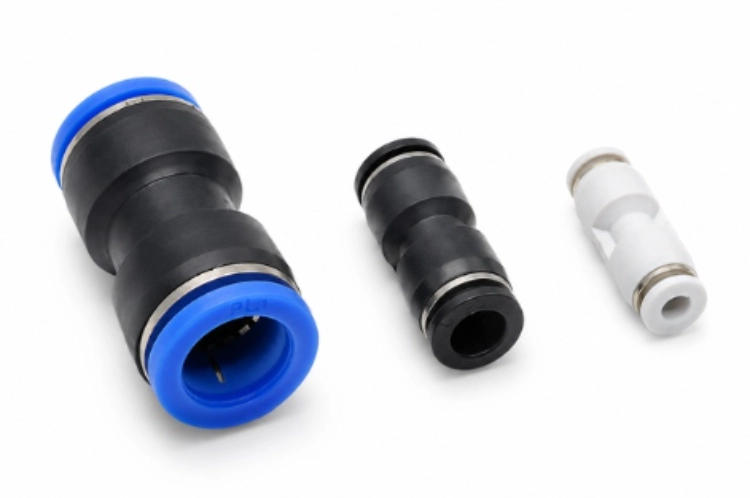
After isolation and venting, pull suspect push-in ends for inspection. A full insertion and square cut matter. Look around the OD where the internal seal grips it. Tube hardness, outside size and fitting bore must suit one another. Where the design allows a joint and enough sound tube remains, a clean trim and compatible straight union fitting can repair the run. If that section was designed as one continuous piece, fit a new length instead.
Verify the component off-line when needed
The cabinet may have too many connected branches to isolate one at a time. After isolation and venting, put the removed valve on a rated fixture. Feed air with the arrow first, then apply the specified reverse pressure for the stated time. Watch the outlet and fixture joints separately. A leaking test connection is not evidence of a leaking valve seat.
Reverse air through the valve under those bench conditions supports replacement. If it holds, return to the installed tube, thread and other outlets.
Read the result and decide what to replace
|
Reading or test |
Next place to look |
|
Forward flow is weak |
Arrow, inlet blockage, available differential, connected port |
|
B falls after A is vented |
Check valve or another outlet from the trapped pocket |
|
A and B fall when supply should hold |
Supply joint, regulator or directional valve exhaust |
|
Reverse air crosses the valve on the fixture |
Valve seat or internal mechanism |
|
Valve holds on the fixture but B falls on the machine |
Tube ends, fittings, threads or branching line |
Put trapped volume, initial pressure, temperature and test time alongside the result. Do not treat a bench pass as proof of safe isolation.
Select a check valve that fits the actual circuit
Before ordering, look at both ends of the installed part. The AKH and AKB stainless steel pneumatic check valves have 304/316 stainless options and a stated working-pressure range of 0–0.9 MPa. That range does not raise the rating of the tube or fittings beside them. Choose to the lowest applicable limit and confirm the exact valve model.
AKH and AKB connection differences
AKH accepts a push-in tube; AKB threads inline. Measure the tube OD or identify the thread form and size on the installed line. Beside the manifold, allow room to tighten and release the part in its arrow direction.
Tube, fitting and operating-condition checks
The label “5 × 8 mm PU” means a 5 mm bore and an 8 mm outside diameter. The push-in port grips the 8 mm dimension. Aisili can supply PU tube in different diameters, hardness grades and colors; the choice belongs in the build record with the fitting code. Wall thickness affects pressure capability, and warmer operation can lower the pressure permitted for a particular tube grade. Check the grade and temperature of this line.
That 5 × 8 size has a 1.5 mm wall. The order should show the bore, OD, hardness, color and length, so the next technician can find the same tube even when the old label has faded. Compressed air is an intended medium; if the branch sees a different fluid, check that separately. Store spare PU tube dry and inspect old stock. Damp storage or a long spell on the shelf can leave it aged or weakened.
Look where the tube crosses the guard. Does it flex with every carton-size adjustment? Does oil or cleaner reach it there? Ether-based PU tubing is one flexible air-line option within its stated limits. Record material, OD, fitting and valve codes together.
Black and transparent PU tubes have the same stated softness. A softer grade can be ordered for cold conditions. Colored tube uses weather-resistant pigment to limit fading during service. Aisili also makes flame-retardant and antistatic TPU extrusions; ordinary PU tube should not be assumed to have either property.
Return the machine to service and prevent a repeat
Use the machine startup procedure after reassembly. Check the disturbed joints, run the stop forward and repeat the same pressure test with A and B in the same places. Keep old and new readings with the part numbers.
For repeated builds, keep the approved tube, fitting and valve together in the parts record. Aisili supplies PU tube and matching fittings, including customized size, hardness, color and performance options. Production is based in Yantai and Linyi on seven extrusion lines. Share the circuit sketch and connection details through the technical contact page.
On a repeat carton-stop build, the same nominal tube size can still raise fitting problems if diameter wanders. Incoming material goes through sixteen internal physical and chemical checks, and tube OD is monitored during extrusion to a stated ±0.12 mm tolerance. Burst pressure, hydrolysis resistance, weathering, flex and bend behavior are also among the checks. Put the approved grade on the repeat order; a spool in the right color is not enough.
Questions maintenance teams ask
Can a check valve replace a lockable isolation valve?
No. Its internal piece responds to pressure. Lock out the source, release residual air and verify the line before opening it.
Why does a new check valve still seem to leak?
Look at the OD and cut, push-in seal, threads, exhaust and arrow. Repeat the original test under the same conditions before changing another part.