


What Self-Locking Features Should OEM Buyers Check in C-Type Pneumatic Quick Couplings
OEM buyers should verify more than whether a C-Type coupling locks. The RFQ should define positive engagement, sleeve retention, sealing, residual-pressure release, cycle life, and the inspection evidence required before production approval.
What does self-locking need to prevent?
The first step is to define what a secure connection must prevent during assembly, operation, and routine service.
Verify full plug engagement
A self-locking coupling should prevent accidental plug release during vibration, hose movement, handling, and routine service. Buyers should require a clear locked position and a repeatable confirmation that the plug is fully seated. The design should not allow a partially inserted plug to appear secure. In a production machine, the coupling is often handled by operators wearing gloves or working around guards, so “locked”must be recognizable by movement or position rather than by guesswork.
During sample approval, test the plug and socket as they will be installed. Check insertion depth, sleeve travel, retention under a straight pull, and the effect of a hose bending beside the connection. If the coupling is mounted behind a panel, repeat the check through the actual access opening. Record the approved engagement position in the drawing or inspection sheet so a visually similar but incomplete connection is rejected.
Which sealing details should be checked?
Once engagement is defined, the next review is how the selected seal performs with the actual medium and installation conditions.
Match the seal to the service medium
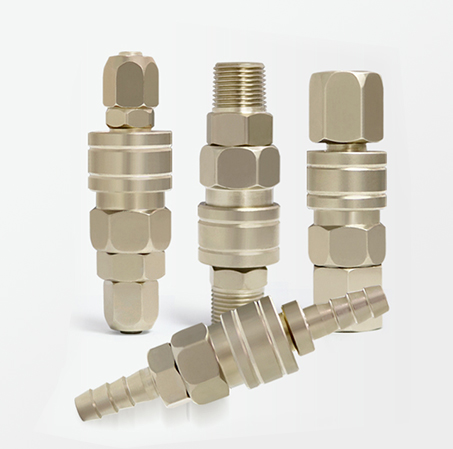
Confirm the sealing element, contact surfaces, pressure range, media compatibility, and maximum permitted leakage. The plug must reach the correct insertion depth before the seal is compressed. Sample approval should test the complete hose-and-coupling assembly rather than the coupling alone. A seal that performs well on a clean bench may behave differently when the hose is cut at an angle, the assembly is side-loaded, or dust and oil are present in the service environment.
Ask the supplier to identify the selected seal option and the body and spring materials on the approved specification. The RFQ should also state the working medium, temperature range, pressure state during connection, and whether cleaning fluids or outdoor humidity are expected. Where the project has a defined leakage limit, use the same test method and hold time for supplier samples and incoming inspection. This keeps the decision tied to evidence instead of a general catalogue rating.
How should residual pressure release be verified?
Sealing alone does not determine safe service behavior, so the release sequence should be reviewed under the equipment pressure condition.
Test the actual isolation sequence
Test connection and disconnection at the pressure used in the finished equipment. Record sleeve movement, air discharge, hose motion, and operator force. If the coupling is used near people or sensitive equipment, define the acceptable release behavior in the RFQ. The test should follow the machine isolation procedure: state whether the branch is vented first, what pressure remains at the coupling, and what the operator is expected to do before pulling the sleeve.
Buyers should distinguish controlled pressure release from simply pulling a pressurized connection apart. Observe whether the hose moves, whether the sleeve can be operated without excessive force, and whether air discharge can reach nearby electronics or a person’s hands. If the supplier recommends a restriction on disconnection under pressure, put that restriction in the work instruction and service documentation before production release.
What should an OEM cycle test include?
After the basic connection and release checks, durability testing should reproduce the loads and access conditions expected in service.
Reproduce hose load and operator access
Specify cycle count, pressure state, pull direction, hose side load, and inspection points. After cycling, check retention, sleeve travel, seal condition, leakage, and connection force. Also test access with gloves or adjacent panel parts if the coupling is installed in a confined space. The useful result is not only a number of cycles; it is a record showing whether the coupling still gives the same engagement indication and sealing behavior at the end of the test.
Include straight insertion, side-loaded hose routing, vibration where relevant, and the actual mating parts used by the equipment. Inspect the plug nose, retaining components, sleeve, and seal for wear or deformation. If replacement parts may be ordered separately, confirm how plugs, sockets, seals, and springs will be identified by part number and drawing revision. Written approval should be required for any substitution that changes the locking geometry or sealing material.
What belongs in the RFQ?
These decisions become useful only when they are converted into measurable RFQ fields and approval evidence.
Set measurable approval criteria
| RFQ item | Specify | Why it matters |
| Profile | C-Type plug and socket, nominal size, thread or hose barb | Prevents interface mismatch |
| Locking | Sleeve action, visual confirmation, retention method | Controls accidental release |
| Sealing | Seal material, pressure, media, leakage limit | Links materials to service conditions |
| Validation | Cycle count, pressure state, pull load, inspection record | Makes approval repeatable |
Need Support Validating C-Type Couplings for Your Equipment?
A coupling decision usually has to be checked against the hose, access space, operating medium, and the service method used by the finished machine. Yantai Aisili New Material Co., Ltd. works as a pneumatic fittings and tubing supplier and sourcing partner for OEM teams that need to align those connection details before a quotation and sample approval. Its About Us information explains the supplier scope, while the C-Type self-locking pneumatic quick coupling page provides the relevant product reference. Buyers can also review the broader pneumatic fittings and connectors range and pneumatic tubing options, then send the required profile, pressure, media, installation envelope, and quantity for a project-specific quotation.
Conclusion
Self-locking performance is a system requirement. Confirm positive engagement, sealing, pressure release, cycle durability, and service access together, then preserve the approved sample and test conditions in the production record.
FAQs
The following questions address common uncertainties when approving and replacing the connection.
1. What is the most important self-locking check?
Confirm that the plug reaches full engagement and that the sleeve provides a clear, repeatable locked position.
2. Should pressure release be tested separately?
Yes. Test connection and disconnection at the pressure state used in the finished equipment.
3. How should cycle testing be specified?
Define the cycle count, pressure state, pull load, hose side load, and post-test leakage and retention checks.
4. Can any hose be used with a C-Type coupling?
No. Hose size, interface, pressure rating, and side-load conditions must be checked as a complete assembly.