


Why OD Tolerance Matters When Polyurethane Pneumatic Tubing Works with Push-In Fittings
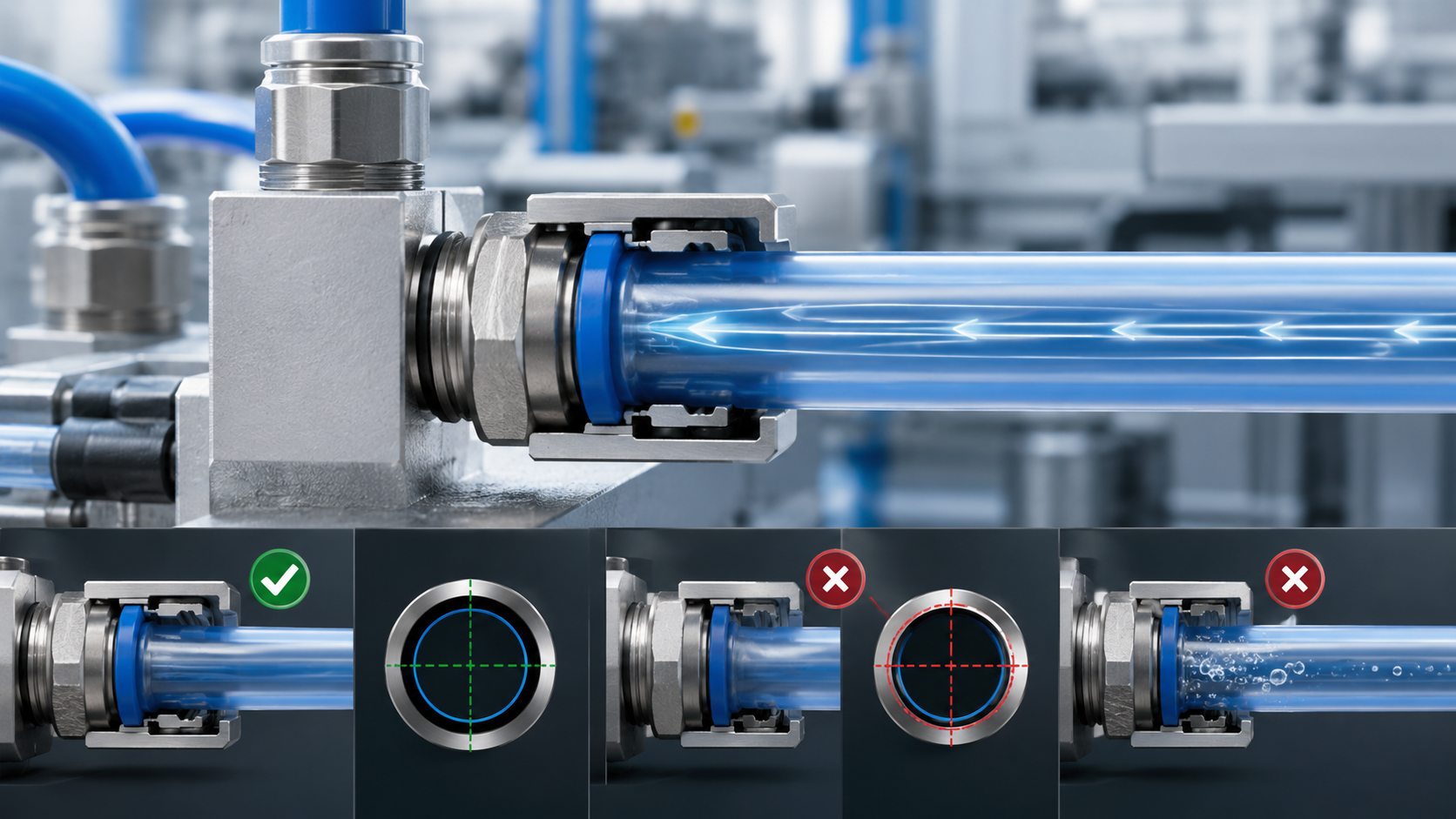
Polyurethane pneumatic tubing (PU tubing) is used in current automation systems. As a very flexible and abrasion-resistant and also chemical-resistant material it is used as pneumatic tubing in automation. Because of its ability to maintain the shape while being under pressure it can be used in dynamic pneumatic circuits. The Push-in fittings can be connected to the PU tubing in a very easy way. Without any tool the connections are done within seconds and are 100% leak-tight. In addition the change of the tubes is much easier than before. The interaction of the outer diameter (OD) tolerance of the pneumatic tubing and the sealing mechanism of the Push-in fittings is important for the functionality of the connections. Small differences of the dimensions can have big effects on the functionality.
Why Does OD Tolerance Matter in Polyurethane Pneumatic Tubing?
This introduction is followed by a precise change of subject to a discussion on the dimensional accuracy and its effects in pneumatic systems.
The Role of OD Tolerance in Pneumatic Systems
OD tolerance defines how accurately the polyurethane pneumatic tubing fits into a push-in fitting’s collet and O-ring seal. In pneumatic applications, maintaining consistent OD ensures balanced sealing pressure across all connections, preventing uneven stress or air loss. When OD values deviate from specification, even by fractions of a millimeter, the fitting may either grip too tightly or fail to seal properly. Therefore, tight OD control contributes directly to stable air pressure delivery and mechanical integrity throughout complex automation networks.
Consequences of Poor OD Control
Inadequate management of OD tolerances can cause a number of problems with a system. Large PU tubing can increase insertion force to the point where it can cause damage to the internal components of the fitting, such as O-rings and collets. On the other hand, small tubing will not generate enough sealing force to provide a reliable seal. When subject to vibration or high pressure pulses, small tubing can suffer from micro-leakage or complete failure. Systems that run tubing with variable tolerances can create problems that require increased levels of maintenance, reduce the energy efficiency of the system due to leaks, and wear the fittings out prematurely.
How Do Push-In Fittings Interact with PU Tubing?
.jpg)
Before we dive into how the manufacturing precision of push-in fittings for polyurethane pneumatic tubing is measured, let’s have a look at how these fittings actually work.
Mechanism of Push-In Fittings
The Push-in Fittings operate by mechanical grip and elastic seal. By inserting the PU tubing, the collet teeth fixate mechanically whilst the O-ring on the inside of the fitting is being compressed to the outer surface of the tubing creating an air-tight seal. For this dual function to be effective, the OD of the tubing has to be within the tolerance. If not, either too much friction is created when pushing in the tubing, or the seal is not being compressed enough to create an air-tight seal.
Factors Affecting Connection Performance
A number of criteria must be taken into consideration when using push-in fittings with polyurethane pneumatic tubing. The most important factors are the hardness of the material, the surface finish, and environmental influences. For example, the material’s hardness influences the degree to which it is compressed by the push-in fitting, and whilst softer tubes are more easily pushed onto the tube end, they can also undergo permanent creep under load. The surface finish of the tube end also plays a significant role in the fit. A smooth surface means that the O-rings are uniformly pressed into contact with the surface, whilst a rough surface can result in the formation of micro-gaps which in turn can create leakage paths. Temperature fluctuations can cause changes in dimension in polyurethane due to thermal expansion/contraction, affecting both the fit and long-term tightness of the connection.
What Are the Key Manufacturing Factors Influencing OD Tolerance?
Following a discussion of the connection mechanics found in PU tubing, this section discusses the production variables that affect the dimensional accuracy of such tubing.
Extrusion Process Control
The geometry of polyurethane pneumatic tubing is determined by the extrusion process. The die for the extruder has to be precisely calibrated in order to achieve constant outer diameters on long lengths of tubing and in correct size. The cooling rate after the extrusion has to be controlled in order to prevent shrinkage or expansion after the production process. Modern feedback systems monitor and influence the production parameters in real time in order to guarantee a high degree of conformity within tight tolerance ranges.
Material Formulation and Quality Stability
Consistency of the material also plays a major role for dimensional accuracy. The quality of the basic polyurethane resin can vary and affect the flexibility as well as the shrinkage of the material during processing. Additives such as plasticizers and stabilizers have to be mixed in a fixed ratio and in excessive amounts they can change the hardness of the material and cause it to swell up over time. A stable formula is a guarantee for the material’s mechanical properties as well as for the accuracy of the dimensions, also across different batches.
How Can Engineers Ensure Compatibility Between PU Tubing and Push-In Fittings?
Following understanding of the production influences, engineers then apply best practices to select suitable materials for their system and to test them.
Selecting Tubing with Verified Dimensional Specifications
Engineers should always verify manufacturer-provided OD tolerance data before integrating polyurethane pneumatic tubing into assemblies. Choosing suppliers who comply with international standards—such as ISO 14743 for fittings—ensures interchangeability across brands and minimizes compatibility risks. Documented inspection reports or certificates of compliance further confirm adherence to specified tolerances.
Testing and Validation Procedures for Assembly Reliability
Practical validation of theoretical compatibility is as important as the insertion force test in order to prevent damage to the fittings due to too tight engagement of the tube. The seal integrity test performed under operating pressure also determines whether there is any air leak over time. The test is performed under realistic operating conditions in order to guarantee long-term reliability of the components before they are put into operation in a plant.
Why Should You Choose Yantai Aisili New Material Co., Ltd. as Your Polyurethane Pneumatic Tubing Supplier?
Yantai Aisili New Material Co., Ltd. stands out as a specialized manufacturer dedicated to precision-engineered polyurethane pneumatic tubing with stringent OD tolerance control. The company utilizes advanced extrusion lines equipped with automated measurement systems to maintain uniformity across production runs while implementing comprehensive quality assurance protocols at every stage of manufacture. In addition, Yantai Aisili New Material Co., Ltd. provides customized solutions tailored for diverse automation environments, ensuring seamless compatibility with leading global push-in fitting brands used in industrial applications.
Conclusion
Ensuring strict OD tolerance when connecting polyurethane pneumatic tubing to push-in fittings within high-performance pneumatic networks is critical to ensuring safe and reliable connections. By accurately selecting the correct size of tubing for the application, any risk of leakage is removed, as well as the need for more frequent maintenance. Using high-quality PU pneumatic tubing not only ensures the best energy transfer, but also extends the life of the associated equipment, by ensuring consistent mechanicalengagement at all connections. Working with a reputable supplier, such as Yantai Aisili New Material Co., Ltd. who adhere to strict manufacturing standards, enables the end user to perform at the highest level within demanding industrial environments where failure is not an option.
FAQs
What happens if polyurethane pneumatic tubing exceeds its specified OD tolerance range?
Greater than the upper limit will be very difficult to insert, could cause damage to the fitting, and will not seal properly due to over compression of the O-ring.
Can temperature fluctuations affect OD tolerance in PU tubing during operation?
Yes, polyurethane materials change in size with temperature. This minor expansion or contraction can affect how well a part fits together and how well a seal holds over time.
How does Yantai Aisili ensure consistent OD control across production batches?
To ensure accurate dimensions throughout the manufacturing process, Yantai Aisili uses automated measurement systems, ongoing monitoring of production processes and strict controls on the materials that are used.